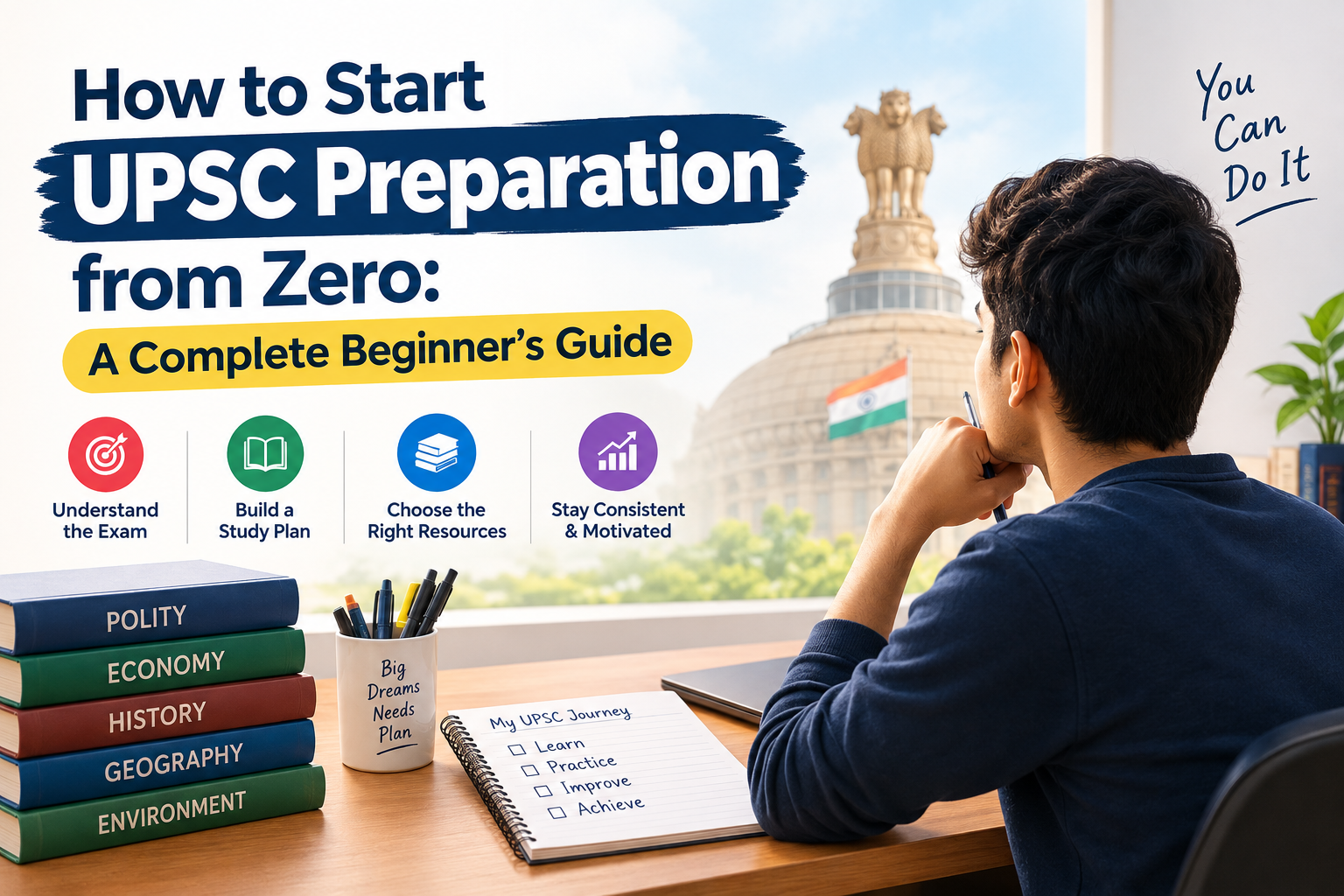
Why Most Beginners Start UPSC Preparation the Wrong Way
Every year, more than ten lakh candidates apply for the UPSC Civil Services Examination, and most of them begin exactly where you are now: no coaching, no notes, and no idea which book to open first. The exam rewards structure more than brilliance. If you set up the right foundation in the first three months, the rest becomes a matter of consistency.
This guide gives you the sequence that works for beginners: understand the exam, finish NCERTs, add one standard book per subject, read one newspaper, and use previous year questions to calibrate everything.
Step 1: Understand the Exam Before You Study for It
Spend your first two days with the official UPSC notification and syllabus, not a coaching summary of it. The examination has three stages, and each stage tests something different.
| Stage | Papers | Marks | What it tests |
|---|---|---|---|
| Prelims | GS Paper I (100 questions) and CSAT (80 questions) | 200 + 200 (CSAT qualifying at 33%) | Factual and conceptual recall under negative marking |
| Mains | Essay, GS I to IV, Optional I and II, two qualifying language papers | 1750 (merit papers) | Analysis, structure and written expression |
| Interview | Personality Test | 275 | Clarity of thought, balance and honesty |
Both Prelims papers carry negative marking of one-third of the marks for each wrong answer. Knowing this changes how you read: a Polity chapter is read once for factual recall and again for arguments and examples.
Step 2: Start with NCERTs, and Actually Finish Them
NCERT textbooks from Class 6 to 12 are the base for History, Geography, Polity, Economy, Science and Environment. They explain concepts in plain language, and UPSC lifts facts and terminology directly from them, especially in Prelims.
Recommended NCERT Order for Beginners
- Geography: Class 11 and 12 first, then Class 6 to 10 for gaps. Keep an atlas open.
- History: Class 12 Themes in Indian History (three parts), then Class 6 to 8 for chronology.
- Polity: Class 11 Indian Constitution at Work, then Class 9 and 10.
- Economy: Class 11 Indian Economic Development and Class 12 Macroeconomics.
- Science: Class 6 to 10 for fundamentals.
- Environment: ecology and biodiversity chapters from Class 12 Biology.
Read each chapter with a pencil, mark keywords, and attempt 15 to 20 MCQs on it immediately. Reading without testing is the single biggest reason beginners forget NCERT content within a month.
Step 3: Build a Minimal Standard Booklist
After NCERTs, add one standard book per subject. Do not collect ten. One book read three times beats three books read once.
- Polity: M. Laxmikanth, Indian Polity
- Modern History: Spectrum, A Brief History of Modern India
- Geography: G.C. Leong, Certificate Physical and Human Geography, plus an atlas
- Economy: NCERT base plus one reference book and the Economic Survey summary
- Environment: Shankar IAS, Environment
- Art and Culture: Nitin Singhania, Indian Art and Culture
Step 4: Start the Newspaper on Day One, but Keep It Small
Pick one newspaper, The Hindu or The Indian Express. In the first month, limit yourself to 45 minutes: front page, national, editorial and economy pages. Skip sports, city and entertainment. Do not make notes yet; you will not know what matters until you have covered some static syllabus. From month two, keep short notes organised by GS paper, not by date.
Step 5: Make Previous Year Questions Your Compass
Before finishing your first NCERT subject, solve the last ten years of Prelims questions on that subject. PYQs tell you three things no book can: what UPSC asks, how it frames a question, and how deep you need to go. Topic-wise PYQ practice is the fastest way to stop wasting time on low-yield chapters.
Step 6: Choose Your Optional by Month Three, Not Month One
The Optional carries 500 marks and often decides final selection, but you cannot choose well on day one. Spend two months on General Studies, then evaluate Optionals on three criteria: genuine interest, availability of material, and overlap with GS. Read one introductory book from your two shortlisted subjects before committing.
A Realistic First 90-Day Plan
| Phase | Static subjects | Practice | Current affairs |
|---|---|---|---|
| Days 1 to 30 | Syllabus, Geography and History NCERTs | 20 MCQs daily | 45 minutes, no notes |
| Days 31 to 60 | Polity and Economy NCERTs, start Laxmikanth | Subject-wise PYQs for Geography and History | Start topic-wise notes |
| Days 61 to 90 | Science and Environment NCERTs, Spectrum | First full-length Prelims mock | Weekly consolidation; shortlist Optional |
Study six to seven focused hours a day in this phase. Track what you completed, not how long you sat.
Mistakes Beginners Should Avoid
- Buying every book recommended on social media
- Watching lecture videos without reading the source book
- Starting Mains answer writing before completing basic syllabus reading
- Comparing progress with candidates in their third attempt
- Reading multiple newspapers and monthly magazines at the same time
A Sample Daily Timetable for a Beginner
Beginners lose more time to an undecided day than to a hard subject. Fix the slots before you fix the books. A workable full-time day looks like this:
| Time | Activity | Purpose |
|---|---|---|
| 6:00 to 9:00 am | Static subject, new chapters (Geography or History in month one) | Hardest reading in the freshest hours |
| 9:30 to 10:15 am | Newspaper | Current affairs without notes in month one |
| 11:00 am to 1:00 pm | Same static subject, next chapters | Complete two to three chapters a day |
| 2:30 to 4:00 pm | MCQs and PYQs on the morning's chapters | Testing converts reading into memory |
| 4:30 to 6:00 pm | Second subject or CSAT basics on alternate days | Keep CSAT from becoming a last-month problem |
| 7:00 to 8:30 pm | Revision of the previous day's keywords | Spaced recall |
Working professionals can compress this into a two-hour morning block, a 40-minute current affairs slot during the commute, and a 90-minute practice block at night, with longer weekend sessions. The structure matters more than the exact hours.
How to Know You Are on Track
By the end of 90 days a beginner should be able to answer yes to four questions: Have I read the syllabus twice? Have I finished the core NCERTs in Geography, History, Polity and Economy? Can I score above 50 per cent on topic-wise PYQs in at least two subjects? Have I taken one full-length mock, however low the score? If two or more answers are no, extend the phase by a month rather than moving on with gaps.
Start Your UPSC Journey with IAS Ladder
The IAS Ladder app gives beginners exactly what this guide recommends: chapter-wise NCERT notes with Recall Mode for active revision, topic-wise MCQs for every chapter, and UPSC previous year questions sorted by subject, all in English and Hindi. Download IAS Ladder and finish your first NCERT chapter with practice questions today.
Watch related video

Practicing UPSC Prelims PYQs?
Practice 45+ years of topic-wise previous year questions (1979–2026) with in-depth explanations on our mobile app.
Never miss a daily update
Join our official Telegram channel or WhatsApp group for daily current affairs and test alerts.
Frequently Asked Questions
Tags
Related Articles

UPSC Cut-Off Marks of the Last 10 Years (2016 to 2025): Prelims, Mains and Final, Category-Wise
Every year's cut-off is a single number that tells you how hard the paper was, how many vacancies there were and where the bar actually sat…

UPSC Second Attempt Strategy: What to Change, What to Keep and How to Plan the Year
A second attempt fails for one of two opposite reasons: everything is restarted from scratch, or nothing is changed and the same year is re…

UPSC Preparation for College Students: A Year-by-Year Plan Alongside Your Degree
College is the cheapest time to prepare for UPSC and the easiest time to waste. This guide gives a year-by-year plan from first year to fin…
Keep reading
More in Preparation Strategy
- Preparation Strategy UPSC Preparation Strategy for Hindi-Medium Aspirants: Sources, Translation Gaps and Answer Writing
- Preparation Strategy Coaching vs Self-Study for UPSC: An Honest Comparison and How to Decide
- Preparation Strategy Complete UPSC Booklist for Beginners: One Source per Subject for Prelims and Mains
- Preparation Strategy UPSC Eligibility, Age Limit and Attempts Explained: Who Can Appear and How Many Times
- Preparation Strategy UPSC Syllabus Explained: Prelims, Mains and Interview Stage by Stage
- Preparation Strategy Common Mistakes UPSC Aspirants Make and How to Avoid Them