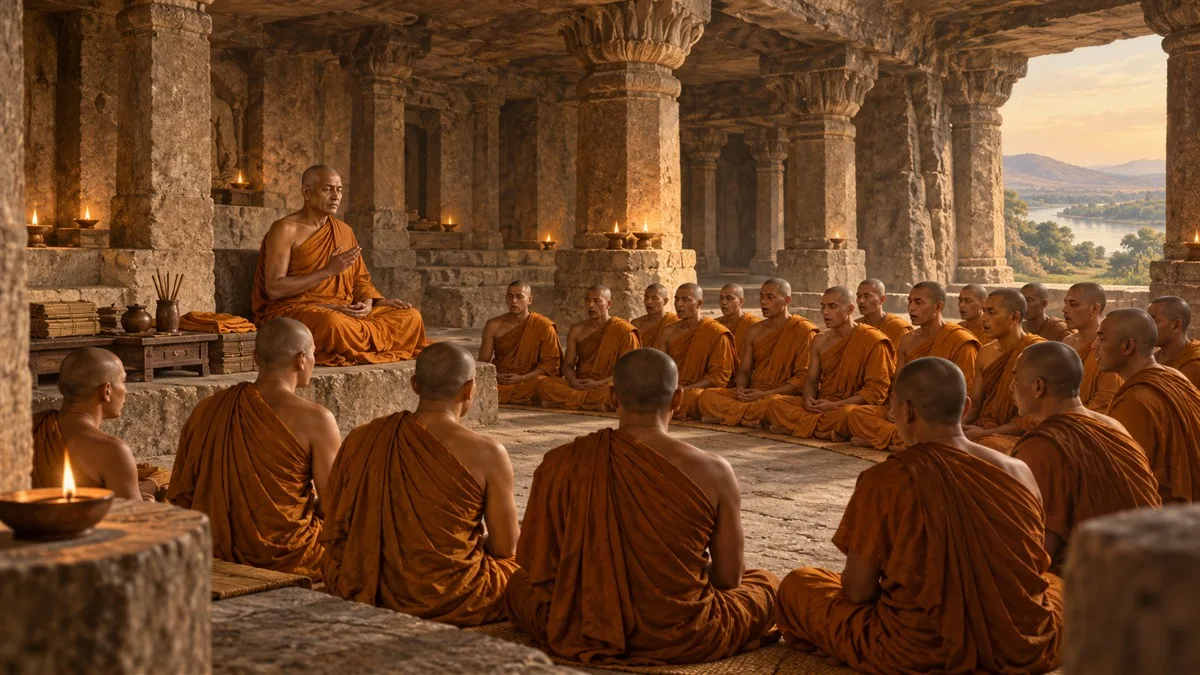
Why do Buddhist books describe several “councils” after the Buddha’s death?
Imagine a community whose teacher has died, whose teachings are remembered aloud, and whose members travel across a large region. How can they preserve the teaching without a single printed text or central archive? Buddhist traditions answer this question through accounts of saṅgīti, often translated as “council” or “communal recitation.” These gatherings are remembered as efforts to recite, organise, interpret, or protect the Buddha’s teaching and the rules of monastic life.
For UPSC and State PCS preparation, the councils matter for two connected reasons. They help explain how Buddhist teachings were transmitted before manuscripts became common, and they show how the Sangha’s internal debates sometimes intersected with royal authority. Yet the familiar list of four councils is not a perfectly settled chronology. Different Buddhist traditions count and describe them differently, and historians assess each narrative against the surviving textual and inscriptional evidence.
What was a Buddhist council?
The word saṅgīti points to reciting together. Early Buddhist communities relied heavily on trained memory, repeated recitation, and collective correction. A council in this setting should not be imagined as a modern legislature, with a fixed membership, official minutes, and a universally binding vote. It was a remembered monastic assembly whose purpose and historical details vary across sources.
The teaching later came to be organised as the Tripiṭaka, or “Three Baskets”: the Sutta Piṭaka, containing discourses; the Vinaya Piṭaka, concerned with monastic discipline; and the Abhidhamma Piṭaka, which systematises doctrinal analysis in some traditions. The term describes the later canon’s broad structure. It does not prove that all three collections existed in their present form at one early meeting.
Two cautions make the topic easier to remember accurately. First, oral preservation is a long process, not necessarily a one-time act of writing down a finished book. Second, a Buddhist chronicle is evidence for how a community understood its past, but it is not automatically a contemporary record of the event it describes.
The First Council: Rajagriha in tradition
According to a widely known account, the First Council met at Rajagriha, usually identified with present-day Rajgir in Bihar, shortly after the Buddha’s parinirvana. The Pali tradition places it in the Sattapanni cave area and associates it with King Ajatasattu. Mahakassapa is described as presiding. Ananda, remembered for his close association with the Buddha, recites the discourses; Upali, known for his knowledge of discipline, recites the Vinaya.
The story gives a powerful model of preservation: teachings are recited by people recognised for their command of particular material, then heard and confirmed by the assembly. But the date is not secure, and the detailed narrative is preserved in later literary accounts, not in a contemporary inscription. Scholars have therefore disagreed about whether a formal council in the full traditional form took place. Charles S. Prebish’s review of scholarship, for example, treats the Rajagriha council as especially doubtful, while later studies argue that traditions about communal recitation may preserve historical elements.
The careful conclusion is not “nothing happened” or “every detail is certain.” The account is important evidence for Buddhist ideas about authority, memory, and continuity. Its exact setting, scale, participants, and final canon cannot be stated as uncontested facts.
The Second Council: discipline at Vaishali
Tradition places the Second Council at Vaishali, roughly a century after the Buddha’s death. The central issue is usually presented as a dispute over monastic discipline. The Pali Vinaya describes ten practices associated with monks at Vaishali that other monks considered improper. The disagreement concerned how rules should be interpreted and observed in everyday life, rather than a simple dispute over one abstract doctrine.
This is historically significant because discipline helped define the Sangha as a community. Rules governed conduct, property, food, communal procedures, and relations with lay supporters. When monks disagreed about acceptable practice, the dispute raised a larger question: who had the authority to decide what counted as faithful observance?
Accounts differ on what followed. Some traditions connect the dispute with an early division between groups later called Sthavira and Mahasanghika. Other scholars caution that the timing and cause of the first major Buddhist schisms are more complicated than a single meeting can explain. The council’s traditional story is useful for understanding the memory of conflict, but the exact relationship between the Vaishali dispute and later schools remains debated.
The Third Council: Ashoka, Pataliputra, and royal involvement
Theravada and Pali chronicles associate a Third Council with Pataliputra during the reign of Ashoka, usually placed in the third century BCE. In this account, the monk Moggaliputta Tissa plays a central role. The assembly is said to have addressed disagreement within the Sangha, clarified orthodox teaching, and been followed by missions to other regions.
Here the relationship between monastery and state becomes more visible. Ashoka’s inscriptions show that the emperor cared about harmony in the Sangha and warned against divisions among monks and nuns. They are valuable contemporary evidence for royal concern with Buddhist institutions. They do not, however, independently confirm every detail in the later Pali account of a council at Pataliputra, the precise role of Moggaliputta Tissa, or the exact missionary list.
That distinction is important for exam answers. Inscriptions and chronicles are different kinds of evidence. Ashokan edicts help establish that the state addressed Sangha unity; later Buddhist texts explain a particular council narrative. Read together, they illuminate the growing public and political importance of Buddhist institutions without making every traditional detail certain.
Why do accounts of the Fourth Council differ?
“Fourth Council” is not a single label used identically by all Buddhist traditions. Northern Buddhist accounts commonly associate a council with King Kanishka and Kashmir, often around the turn of the Common Era or in the early centuries CE. These narratives connect the gathering with the Sarvastivada tradition and the organisation or commentary of its teachings. Dates and details vary in later sources.
Theravada histories use the same ordinal number for a different event: the tradition that the Pali canon was committed to writing in Sri Lanka, often associated with the first century BCE and a period of political hardship. This account highlights a transition from oral preservation to written manuscripts. It should not be merged with the Kashmir narrative simply because both are called “fourth.”
The difference teaches a broader lesson about canon formation. Buddhist schools developed their own textual lineages, languages, commentaries, and memories of important assemblies. “The Buddhist canon” is therefore not one identical book produced at one universally recognised council. The Pali, Sanskrit, Chinese, and Tibetan transmission histories reflect distinct communities and stages of preservation.
How historians evaluate the council traditions
Historians compare versions preserved in different Vinaya traditions, chronicles, inscriptions, and later commentaries. Agreement across independent textual lineages can strengthen the case that a remembered dispute or assembly has an early basis. Differences in participants, dates, locations, and outcomes warn against treating one version as a verbatim report. Inscriptions provide a different check, but silence in an inscription does not by itself prove that an event never occurred.
There is no need to force a false choice between tradition and history. A narrative can preserve a community’s institutional memory even when its exact chronology is uncertain. The First Council may tell us as much about later Buddhist concerns over authority as it does about the first generation after the Buddha. The Vaishali story places discipline at the centre of communal identity. The Ashokan tradition reflects the growing role of rulers in supporting or regulating religious institutions.
When writing an answer, separate three levels: what a tradition says; what contemporary evidence independently supports; and what remains disputed. This method is stronger than memorising a rigid sequence of dates and presenting every detail as settled fact.
UPSC and State PCS exam takeaways
For Prelims, remember the broad traditional associations: Rajagriha with the First Council; Vaishali with a dispute over monastic practices; Pataliputra and Ashoka with the Theravada account of the Third Council; and two different events counted as the Fourth in northern and Theravada traditions. Avoid treating a date or a claimed schism as universally agreed unless the question specifies a tradition.
For Mains, connect councils with oral transmission, the development of the Tripiṭaka, the formation of Buddhist schools, and the relationship between the Sangha and political power. A balanced answer should explain both the historical significance of communal recitation and the limits of the evidence. This is also a useful example of how historians reconstruct ancient history from texts produced within religious communities and compare them with inscriptions and archaeology.
Revision takeaway: Buddhist councils are best understood as traditions about preserving and authorising teachings, not as one uniform series of universally documented conferences. Memorise the standard locations and associations, then qualify contested details by naming the tradition behind them.
Practicing UPSC Prelims PYQs?
Practice 45+ years of topic-wise previous year questions (1979–2026) with in-depth explanations on our mobile app.
Never miss a daily update
Join our official Telegram channel or WhatsApp group for daily current affairs and test alerts.
Frequently Asked Questions
Test yourself · 10 practice questions
Practice MCQs on Buddhist Councils: How the Canon Was Preserved
Check how well you understood this article with 10 UPSC-style multiple-choice questions — instant answers with detailed explanations.
View all questions with answersTags
Related Articles
Money Bills under Article 110: Rules, Process and Limits
Article 110 gives a narrow constitutional test for identifying a Money Bill, while Article 109 sets out the special route through Parliamen…

Fundamental Duties in India: Article 51A Explained
Fundamental Duties under Article 51A describe the responsibilities of citizens in India’s constitutional democracy. Learn their origin, all…
Colonial Land Revenue: Permanent, Ryotwari and Mahalwari
What was permanent in the Permanent Settlement, and what did direct settlement with a ryot actually change? Compare colonial revenue system…