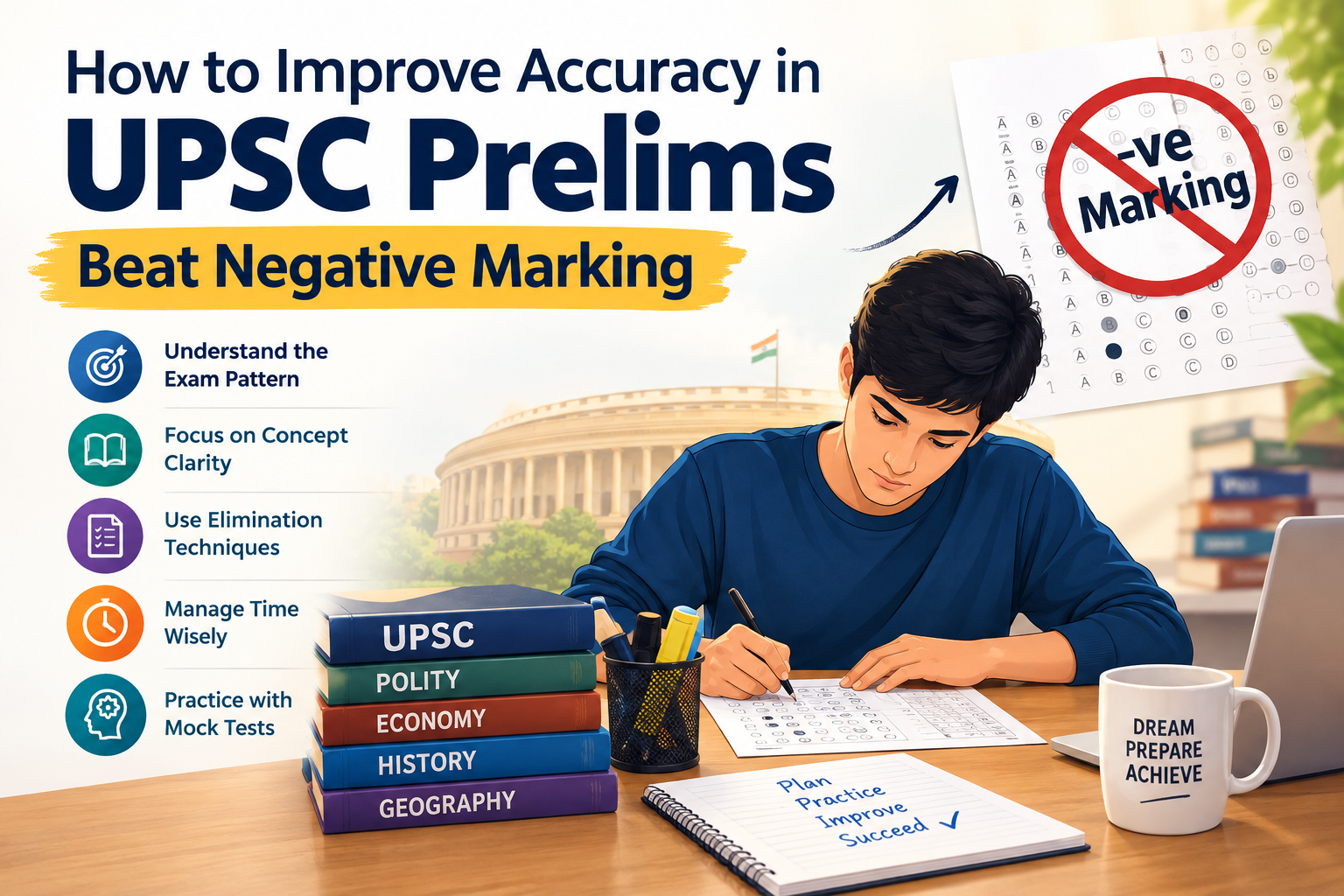
Why Accuracy Decides UPSC Prelims More Than Knowledge
In UPSC Prelims GS Paper I, each correct answer earns two marks and each wrong answer costs 0.66. Three wrong answers cancel one right answer. A candidate who attempts 90 questions at 60 per cent accuracy scores about 88; one who attempts 75 at 75 per cent accuracy scores about 100. The second candidate knew less and scored more.
Accuracy is not a personality trait. It is a set of habits that can be trained in eight to twelve weeks. This article shows you where marks are actually lost and seven techniques to stop losing them.
Find Out Where Your Marks Are Actually Lost
Analyse your last three mocks and sort every wrong answer into one of five buckets.
| Bucket | What happened | The fix |
|---|---|---|
| Knowledge gap | You did not know the fact at all | Reading and revision |
| Partial knowledge | You knew something but not enough to eliminate | Targeted revision of that micro-topic |
| Misread question | Missed "not", "only", "incorrect", "how many" | Qualifier underlining |
| Elimination failure | Narrowed to two options and picked wrong | Elimination practice, not more reading |
| Blind guess | No basis for the answer | Attempt discipline |
Most candidates assume the knowledge gap dominates. In practice, misreads, elimination failures and blind guesses account for about half of lost marks, and those are the fixable ones.
Seven Techniques to Improve Accuracy
1. Read the Question Twice, the Options Once
UPSC questions are engineered around qualifiers. "Which of the following statements is not correct" and "how many of the above statements are correct" trap the most candidates. Underline the qualifier physically before reading the options. It costs three seconds and saves a dozen marks over a paper.
2. Master the Statement-Based Formats
For "how many of the above statements are correct" questions, you must judge each statement independently with a confidence level: certain, likely or unknown. Attempt if you are certain about all but one statement. Skip if you are uncertain about two or more, unless the options let you eliminate.
3. Eliminate Before You Select
Do not look for the right answer; look for wrong ones. Common eliminators in UPSC:
- Extreme words such as "always", "never", "only", "all" and "completely" are usually wrong in statement-based questions
- Mismatched pairs: a scheme with the wrong ministry, a river with the wrong state
- Anachronisms: an institution mentioned before it existed
- Option structure: if two options are logically identical, both are wrong
4. Use the Three-Round Attempt Strategy
- Round 1 (35 to 40 minutes): answer only questions you are sure about. Mark the rest as 50-50 or unknown.
- Round 2 (40 to 45 minutes): attempt the 50-50 questions using elimination, only if you can reduce to two options with reasoning.
- Round 3 (last 15 minutes): decide on the remaining questions based on your running attempt count.
This prevents early time loss on hard questions and gives you control over your final attempt number.
5. Know Your Personal Attempt Number
Your ideal attempt count is not 90 or 100 because someone said so. From ten mocks, calculate your accuracy on sure questions, on 50-50 questions and on guesses. Most candidates find 50-50 questions land at 55 to 65 per cent accuracy, which is worth attempting, while blind guesses land at 25 to 35 per cent, which is a net loss.
6. Maintain an Error Log
For every wrong answer in a mock or PYQ set, record the topic, the bucket from the table above, and what you should have known or noticed. Review the log weekly. Aspirants who keep an error log for eight weeks typically raise accuracy by 10 to 15 percentage points, because the same trap questions stop working on them.
7. Simulate Exam Conditions
Accuracy drops under time pressure and fatigue. Take mocks at the actual exam time, on paper, with an OMR sheet, in one sitting. Fill the OMR in batches of ten so a mismatch is caught early.
Subject-Wise Accuracy Patterns You Should Know
Accuracy problems are not evenly spread across the paper. Each subject has a typical failure mode, and knowing it tells you what to practise.
| Subject | Typical accuracy trap | What to practise |
|---|---|---|
| Polity | Near-identical provisions (President vs Governor, Article 352 vs 356) | Comparison tables and pairwise recall |
| Modern History | Sequence and personality-event mismatches | Timeline recall, session-by-session lists |
| Geography | Map location and direction questions | Daily atlas work; river, pass and peak mapping |
| Economy | Conceptual reversals (effect of repo rate, CAD direction) | Cause-effect statements, not definitions |
| Environment | Protected area and species pairs | State-wise lists of national parks and species |
| Current affairs | Scheme features and ministry mismatches | Monthly tests on scheme details |
Run your error log by subject once a fortnight. If one subject contributes more than a third of your wrong answers, give it a dedicated ten-day accuracy cycle before the next full mock.
The Last Two Weeks: Accuracy Over Coverage
In the final fortnight, stop reading new material. Every hour spent on a new chapter is an hour not spent on the traps you already fall into. Revise from your keyword notes and error log, take two timed mocks, and finalise your personal attempt number and round-wise timing. Sleep matters more than one more revision: fatigue is the largest single cause of misreads on exam day.
What Not to Do
- Do not attempt more questions to compensate for a weak subject
- Do not change answers in the last five minutes without a concrete reason
- Do not skip CSAT practice because it is only qualifying; it fails hundreds of candidates every year
- Do not solve mocks without analysis; the score is the least useful output of a mock
Build Accuracy with Topic-Wise Practice on IAS Ladder
Accuracy comes from meeting the same question patterns repeatedly. IAS Ladder gives you UPSC previous year questions sorted by subject and topic, chapter-wise MCQs in the statement-based format UPSC uses, and accuracy tracking that shows which subjects are costing you marks. Available in English and Hindi. Download IAS Ladder and start your error log today.
Practicing UPSC Prelims PYQs?
Practice 45+ years of topic-wise previous year questions (1979–2026) with in-depth explanations on our mobile app.
Never miss a daily update
Join our official Telegram channel or WhatsApp group for daily current affairs and test alerts.
Frequently Asked Questions
Tags
Related Articles

What Is a Safe Score in UPSC Prelims? How to Set Your Target from Ten Years of Cut-Off Data
Every aspirant asks what score is safe in Prelims and most get a number with no reasoning behind it. This post derives the target from the …

How to Prepare Map-Based Questions for UPSC Prelims: Atlas Method, Lists and Practice
Map questions appear every year, are lost by candidates who never opened an atlas, and are among the most recoverable marks in the paper. T…

How to Choose a UPSC Prelims Test Series: Seven Criteria That Actually Matter
A test series is the one paid product almost every serious aspirant buys, and most choose it by brand or by a friend's recommendation. This…
Keep reading
More in UPSC CSE
- Prelims Why UPSC Prelims Candidates Lose Marks Despite Knowing the Answer
- Prelims How to Approach UPSC Prelims Mock Tests: When to Start, How Many, and How to Analyse
- Prelims UPSC Prelims Revision Strategy for the Last 30 Days: A Day-by-Day Plan
- Prelims How to Prepare for UPSC Prelims: Subject-Wise Strategy for GS Paper I
- Optional & Subjects Colonial Land Revenue: Permanent, Ryotwari and Mahalwari
- Current Affairs Pumped Storage Hydropower: Energy, Efficiency and the Grid