Why storing electricity matters as much as producing it
The Bharat Renewable Energy Summit and Expo 2026 opened in New Delhi on 2 November 2026, bringing energy storage and grid integration into the discussion on clean-energy expansion. The summit is scheduled for 2–5 November. For India, the central challenge is increasingly about delivering electricity when it is required, alongside adding new generating capacity. Facts and event status in this article were checked on 3 November 2026.
Pumped-storage hydropower helps address that timing problem. It uses electricity to raise water and later releases the water to generate electricity. The arrangement is often compared with a battery, although the stored energy is gravitational rather than electrochemical. Understanding this distinction explains why a plant can consume more electricity than it returns and still provide a valuable service.
The subject connects energy infrastructure, renewable integration and environmental assessment in GS Paper III. It also offers useful Prelims distinctions: megawatts versus megawatt-hours, storage versus a primary energy source, and a closed water cycle versus a project without environmental impacts.
How the pumping and generating cycle works
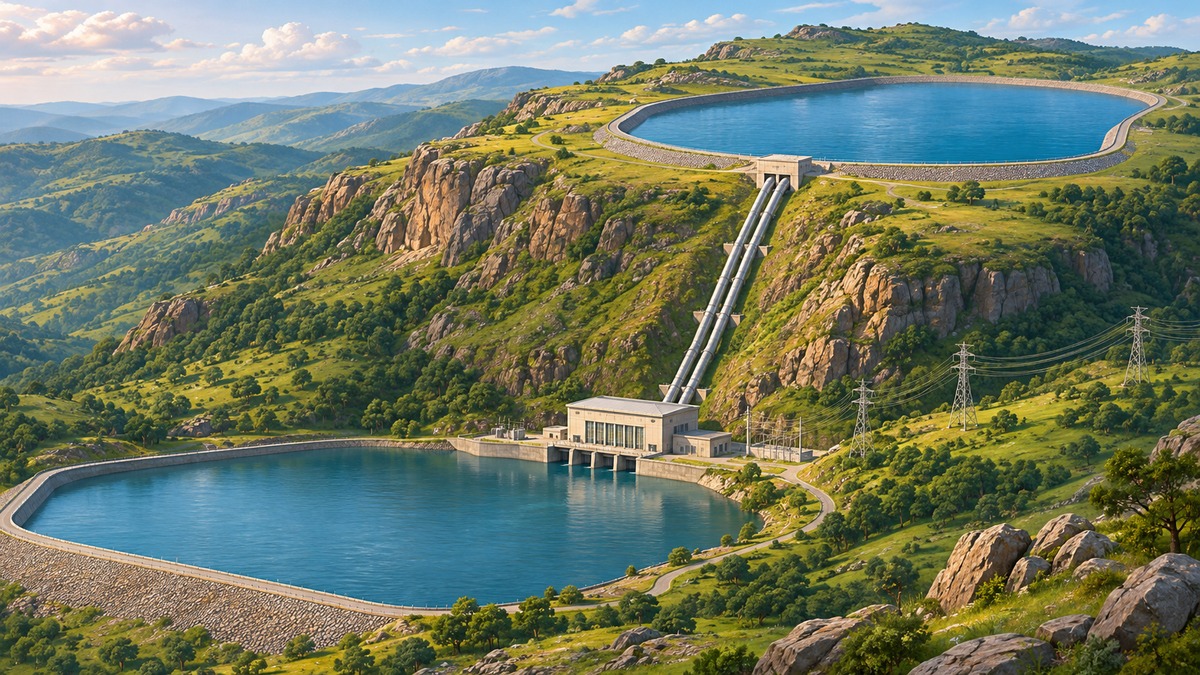
A typical pumped-storage project has upper and lower reservoirs separated by an elevation difference. During charging, electricity drives pumps that move water uphill. During discharge, water flows downhill through turbines connected to generators. The water can then be pumped back for another cycle.
Raising water increases its gravitational potential energy. In an idealised calculation, this energy depends on the mass of water, gravitational acceleration and vertical height difference. Actual output also depends on equipment efficiency and hydraulic losses. More usable water or a greater effective height difference can increase the energy available, but neither variable alone settles whether a site is feasible.
Charging need not occur only at night. In a system with abundant midday solar output, pumping may be useful during daylight hours, followed by generation during the evening peak. The relevant condition is the availability and value of electricity at different times, rather than a fixed day-versus-night rule.
In a pure storage cycle, the plant shifts energy supplied by another generator; it does not create a net addition to that energy. Some projects also receive natural inflows, which complicate accounting. Therefore, distinguish electricity recovered from previously pumped water from electricity attributable to incoming river water when comparing operating data.
Power, energy and duration answer different questions
Power capacity, expressed in megawatts or gigawatts, describes the rate at which electricity can be delivered. Energy capacity, expressed in megawatt-hours or gigawatt-hours, describes the amount that can be delivered over time. A high power rating does not, by itself, establish long-duration support.
Consider an illustrative facility with a discharge limit of 500 MW and 3,000 MWh of usable electrical output stored. If it begins fully charged and supplies 500 MW continuously, its nominal duration is six hours: 3,000 divided by 500. This simplified example assumes no additional inflow or recharge and no further derating.
| Measure | Meaning | Illustrative value |
|---|---|---|
| Power capacity | Maximum discharge rate | 500 MW |
| Usable energy | Electrical output available from a full charge | 3,000 MWh |
| Nominal duration | Energy divided by discharge rate | 6 hours at 500 MW |
Compare this with a second facility rated at 1,000 MW but holding the same 3,000 MWh of usable energy. Its full-power duration would be three hours. It can supply a larger short-term requirement but cannot sustain that higher output for six hours. Conversely, expanding a reservoir's usable storage without upgrading the generating equipment need not increase maximum power output.
Round-trip efficiency and the value of losses
Round-trip efficiency is electricity recovered divided by electricity consumed in a complete charging-and-discharging cycle. Losses occur in pumps, turbines, generators, motors and water conveyance. An illustrative 80% efficient cycle receiving 1,000 MWh returns 800 MWh. The missing 200 MWh is an energy loss, not extra electricity awaiting a later release.
Losses do not automatically make storage useless. Electricity that would otherwise be curtailed during a surplus period may have little immediate system value, whereas electricity supplied during a shortage can be highly valuable. Storage provides a time-shifting service; its purpose is not to defeat energy conservation.
Nevertheless, a higher selling price does not guarantee a positive operating margin. Suppose charging electricity costs ₹2 per kWh and round-trip efficiency is 80%. To deliver one kWh, the plant must buy 1.25 kWh, costing ₹2.50. Selling at ₹2.40 produces a loss even before other expenses, despite the selling price exceeding the purchase price per unit.
This is a simplified illustration, not a project tariff. Financing, maintenance, transmission charges and payments for other services also matter. A sound comparison must state which costs and revenues are included rather than treating a price difference as guaranteed profit.
Open-loop and closed-loop projects
Open-loop pumped storage has an ongoing hydrological connection with a natural water body. Closed-loop storage does not have that continuous connection; water circulates between reservoirs designed for the storage cycle. This classification concerns the relationship with natural waters, not whether electricity comes from solar panels or thermal stations.
Closed-loop projects can reduce some direct effects on river systems compared with open-loop designs. But closed-loop does not mean water-free or impact-free. Initial filling requires water, while evaporation and seepage can create replacement needs. The source and timing of that supply matter, especially in water-stressed locations.
Reservoirs, access roads, tunnels and transmission lines also occupy land and can affect habitats and communities. Geological conditions, slope stability, reservoir safety and construction spoil require assessment. A project outside a river channel can still have substantial local consequences; its advantages must be established through site-specific comparison.
What storage contributes to the electricity system
Solar output can be high when demand is relatively low and fall as evening demand rises. Wind generation also varies. Pumped storage can absorb some surplus electricity and release it later, reducing renewable curtailment where charging opportunities and grid connections permit. Curtailment means deliberately reducing otherwise available generation because the system cannot accept or use it at that time.
The system can also benefit from flexibility: changing output to help balance supply and demand. Frequency control, reserve provision and other grid services may add value, depending on equipment, operating mode and applicable technical requirements. Do not assume that every project provides every service in every operating condition.
Storage does not remove all network constraints. If a congested transmission corridor prevents surplus electricity from reaching the pumps, the available water-storage capacity cannot absorb that electricity. If the discharge connection is inadequate, stored energy may not reach consumers at the required rate. Storage and transmission planning must therefore be coordinated.
Nor can a six-hour installation automatically cover several days of low renewable output. Reliability depends on duration, state of charge, future charging opportunities and the rest of the power system. Demand response, transmission, diverse generation and different storage technologies can complement one another.
Pumped storage and batteries: compare the required service
Battery systems are relatively modular and can be installed near generation or consumption centres. Pumped-storage projects depend more strongly on suitable terrain, water arrangements and major civil works. Their potential for large energy volumes and long operating lives makes them useful candidates for sustained storage services.
These are comparative tendencies, not universal limits. Batteries are not restricted by definition to very short durations, and pumped-storage equipment can also respond quickly. The appropriate choice depends on discharge duration, response requirements, land, construction time, network access, lifetime costs and environmental conditions.
A technology comparison should use the same service requirement. Comparing a short-duration battery with a much longer-duration hydro project only by cost per MW can conceal differences in stored energy. Power cost and energy cost describe different parts of the investment; neither metric alone provides a complete ranking.
Environmental performance depends on the full system
Water passing through a turbine does not involve fuel combustion at that point, but this does not make the entire storage cycle automatically carbon-free. The electricity used for pumping has a generation mix, and construction and operation have environmental effects. The emissions outcome also depends on which generation is displaced when stored electricity is released.
For a simplified illustration, charging electricity with an emissions intensity of 0.4 kilograms per kWh and 80% round-trip efficiency implies 0.5 kilograms per delivered kWh from charging alone. This excludes construction and other effects. The calculation shows why losses matter for emissions accounting; it does not establish a universal emissions value for pumped storage.
If the stored electricity displaces more emissions-intensive generation, there may still be a benefit. If charging relies heavily on high-emission generation and displaces cleaner output, the result can differ. Assessment should examine the actual charging source, dispatch pattern and credible comparison scenario.
What India should prioritise
Investment decisions should distinguish operating capacity from proposed or assessed potential. A promising site still needs investigations, approvals, financing, construction and a workable connection to the grid. A large project pipeline is not equivalent to electricity available during tonight's peak.
Better project preparation includes credible water balances, geological studies, environmental safeguards, community engagement and rehabilitation where required. Procurement should specify the required MW, MWh, duration, availability and response characteristics. Clear arrangements for charging energy and payment for grid services can make responsibilities easier to evaluate.
For Mains, the balanced conclusion is that pumped storage can support renewable integration, but its value depends on location, operation and safeguards. Neither dismissing it because of energy losses nor declaring it universally clean captures the relevant trade-offs.
- Pumping stores gravitational potential energy; discharge recovers only part of the charging electricity.
- MW measures power, MWh measures energy, and their ratio gives nominal duration.
- Closed-loop describes hydrological connectivity, not the absence of water use or impacts.
- Storage needs suitable charging opportunities and transmission access.
- Evaluate costs, emissions and reliability against a clearly stated service and comparison case.
Practise next: Attempt related MCQs and revise energy-storage concepts in the IASLadder app.
Practicing UPSC Prelims PYQs?
Practice 45+ years of topic-wise previous year questions (1979–2026) with in-depth explanations on our mobile app.
Never miss a daily update
Join our official Telegram channel or WhatsApp group for daily current affairs and test alerts.
Frequently Asked Questions
Test yourself · 10 practice questions
Practice MCQs on Pumped Storage Hydropower: Energy, Efficiency and the Grid
Check how well you understood this article with 10 UPSC-style multiple-choice questions — instant answers with detailed explanations.
View all questions with answersTags
Related Articles

Khelo India Sports Goods Scheme: Manufacturing and MSMEs
The new sports-goods manufacturing scheme connects equipment production with industrial policy. Explore shared facilities, anchor firms, ce…

National Unity Day: Patel, Integration and India’s Union
National Unity Day connects Patel’s legacy with the making of India’s constitutional Union. Understand how accession differed from administ…

PM Viksit Gram Swaraj Yojana: Panchayats and Local Governance
The new rural-governance scheme connects Panchayat planning, capacity building and financial accountability. Understand its approved design…
Keep reading
More in Current Affairs
- Current Affairs Immersive Technologies: AR, VR and Mixed Reality
- Current Affairs Agrivoltaics: Growing Crops Alongside Solar Power
- Current Affairs SIMBEX 2026: India–Singapore Maritime Cooperation
- Current Affairs Green Diwali 2026: Clean Air and Governance for UPSC
- Current Affairs Children’s Internet Rights and Online Safety: Supreme Court Order
- Current Affairs How to Use PIB, Yojana and PRS for UPSC: What Each Source Gives and How Much to Read