Why in news
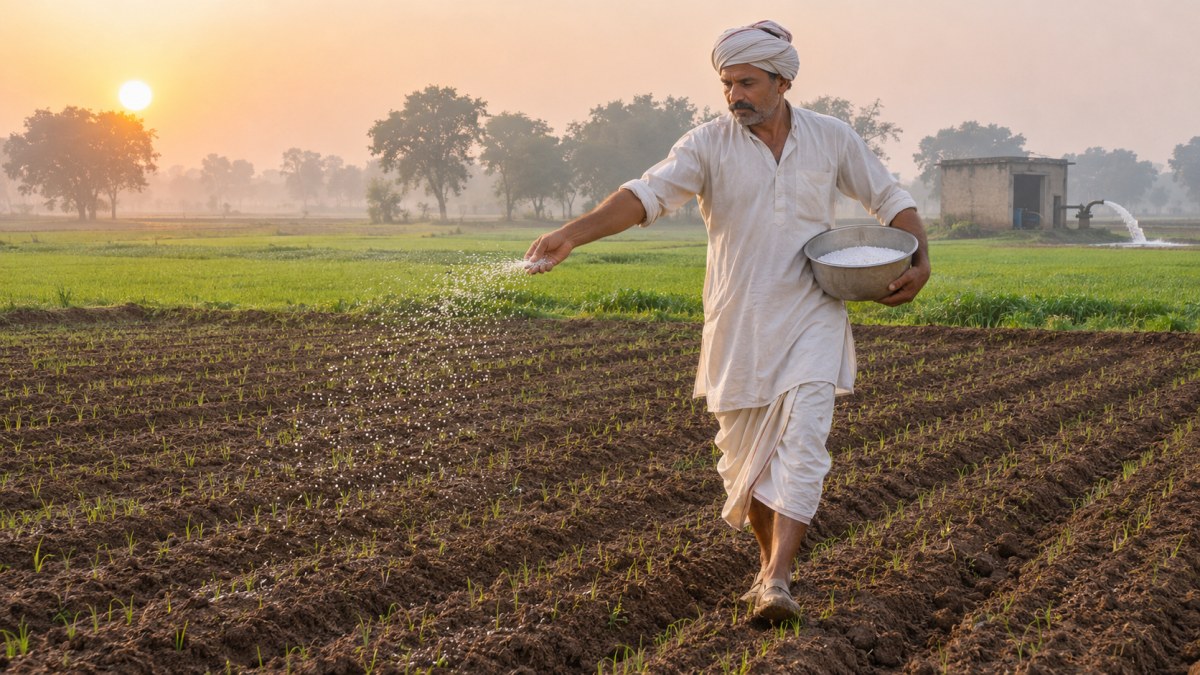
On 11 November 2026, the Union Cabinet approved Nutrient Based Subsidy (NBS) rates on phosphatic and potassic (P&K) fertilisers for the Rabi 2026-27 season. The tentative budgetary requirement is about ₹62,370 crore, roughly ₹24,418 crore (about 64 per cent) more than the ₹37,952 crore required for Rabi 2025-26. The rates apply from 1 October 2026 to 31 March 2027 and cover 28 grades of P&K fertilisers, including di-ammonium phosphate (DAP) and various NPKS grades. The Cabinet linked the decision to recent trends in international prices of fertilisers and inputs such as urea, DAP, muriate of potash (MOP) and sulphur. The retail price of DAP is to remain ₹1,350 per 50-kg bag.
The decision is a useful entry point into one of the largest subsidies in the Union Budget and into a policy design that treats nitrogen very differently from phosphorus and potassium.
Background: why fertilisers are subsidised
Plants need three primary nutrients: nitrogen (N), phosphorus (P) and potassium (K). Sulphur (S) is an important secondary nutrient, especially for oilseeds and pulses. Chemical fertilisers became central to Indian agriculture with the Green Revolution, when high-yielding varieties of wheat and rice needed assured nutrients and irrigation to deliver their potential.
India depends heavily on imports for these nutrients. Urea is made from ammonia, which is produced mainly from natural gas, a large part of it imported. For phosphates, India imports finished DAP as well as rock phosphate and phosphoric acid. Potash is almost entirely imported because India has no commercially exploited potash reserves. Sulphur for phosphoric acid largely comes as a by-product of oil refineries. Global price swings, such as those after supply disruptions, therefore pass quickly into the cost of production in India. The subsidy shields farmers from these swings and keeps fertiliser affordable.
Two regimes: urea and P&K fertilisers
The single most important fact for this topic is that India runs two different subsidy systems.
| Feature | Urea | P&K fertilisers (DAP, MOP, NPKS, SSP) |
|---|---|---|
| Retail price | Fixed by the Government (statutorily notified maximum retail price) | Decontrolled; companies fix the price, which the Government monitors for reasonableness |
| Subsidy | Difference between the cost of production or import and the fixed retail price; varies by unit | Fixed rate per kilogram of nutrient (N, P, K, S) under NBS |
| Price to farmer | Low and unchanged for years (₹242 per 45-kg bag, excluding neem-coating charges and taxes) | Higher; varies with global prices and subsidy rates |
| Effect | Encourages overuse of nitrogen | Farmers bear more of the price change |
Because urea is far cheaper per kilogram of nutrient than P&K fertilisers, farmers tend to apply excess nitrogen and too little phosphorus and potassium. This price distortion is at the root of India's nutrient imbalance.
How the Nutrient Based Subsidy works
The NBS scheme has been in force since 1 April 2010. Instead of subsidising each product, the Government announces a subsidy per kilogram of each nutrient: N, P, K and S. A fertiliser's subsidy is calculated from its nutrient content. Rates are fixed for each Kharif and Rabi season, so they can respond to international prices.
| Fertiliser | Nutrient content | Point to remember |
|---|---|---|
| Urea | 46% N | Outside NBS; price fixed by the Government |
| DAP (di-ammonium phosphate) | 18% N, 46% P₂O₅ | Second most used fertiliser; under NBS |
| MOP (muriate of potash) | 60% K₂O | Entirely import-based; under NBS |
| SSP (single super phosphate) | 16% P₂O₅ with sulphur | Domestically made; under NBS |
The subsidy is paid to manufacturers and importers, not directly into farmers' bank accounts. Under the direct benefit transfer system in fertilisers, the company receives the subsidy only after a sale to a farmer is recorded on a point-of-sale device at the retailer, using the buyer's Aadhaar authentication. Farmers benefit through a lower retail price.
Key facts for Prelims
- NBS covers P&K fertilisers only; urea remains under a separate pricing and subsidy regime.
- NBS rates are fixed per kilogram of nutrient (N, P, K, S) and announced seasonally.
- The Rabi 2026-27 approval covers 28 grades and applies from 1 October 2026 to 31 March 2027.
- Since 2015, all urea produced and imported in India has been neem-coated. The coating slows the release of nitrogen, improving nutrient use, and makes diversion of subsidised urea to industrial uses difficult.
- Ammonia, the input for urea, comes mainly from natural gas; coal gasification is being promoted as an alternative feedstock.
- The Soil Health Card scheme gives farmers crop-wise recommendations on nutrients and fertilisers to curb their overuse.
- PM-PRANAM (2023) encourages States to reduce chemical fertiliser use by sharing part of the subsidy saved with them.
Mains angle: issues
Nutrient imbalance and soil health
Agronomists commonly cite an N:P:K ratio of about 4:2:1 as a broad benchmark for Indian conditions, but actual use is skewed heavily towards nitrogen. Excessive nitrogen acidifies soil over time, causes nitrate to leach into groundwater, and releases nitrous oxide, a potent greenhouse gas. Deficiencies of sulphur, zinc and other micronutrients are spreading, which limits the response to fertilisers and lowers factor productivity.
Fiscal burden and volatility
Fertiliser subsidy depends on global prices that India cannot control. A 64 per cent jump in the season's P&K requirement shows how quickly the bill can rise. Large, unpredictable outlays strain budgets and may delay payments to companies.
Import dependence
Dependence on imported gas, phosphate rock, phosphoric acid and potash exposes farm input supply to geopolitical shocks and the exchange rate. This is a strategic, not just economic, vulnerability.
Leakages
Cheap urea is prone to diversion to industries such as plywood, resins and animal feed, and to smuggling across borders. Neem coating and point-of-sale tracking have reduced but not eliminated this problem.
Way forward
- Price parity across nutrients: gradually bringing urea closer to a nutrient-based approach would reduce the incentive to overuse nitrogen, though it must be phased to protect small farmers.
- Balanced and site-specific use: linking Soil Health Card recommendations to purchases, and promoting customised and fortified fertilisers.
- Efficiency: fertigation, slow-release products and newer formulations such as nano fertilisers, whose field performance must be validated through independent trials.
- Organic and biological sources: manure, compost, biofertilisers and crop rotation with legumes to reduce dependence on chemical nitrogen.
- Supply security: long-term import contracts, joint ventures abroad for phosphate and potash, and alternative feedstocks such as coal gasification and green ammonia.
- Direct transfers to farmers: moving subsidy payments from companies to farmers is often discussed, but it requires land and tenancy records that capture actual cultivators.
Link to the static syllabus
- GS Paper III: direct and indirect farm subsidies; issues related to agricultural input prices; e-technology in aid of farmers.
- GS Paper III (Environment): soil degradation, nitrate pollution of groundwater and greenhouse gas emissions from agriculture.
- Economy (Prelims): subsidy expenditure in the Union Budget, import dependence and the balance of payments.
- Geography: distribution of fertiliser plants and of natural gas and mineral resources.
PYQ connection
UPSC Prelims has tested this theme several times. In 2020, a question asked whether the retail price of chemical fertilisers is market-driven, whether ammonia for urea is produced from natural gas, and whether sulphur for phosphoric acid is a refinery by-product. Questions in 2016 asked why neem-coated urea is promoted, and in 2015 about the effects of excessive nitrogenous fertiliser use. A 2017 question covered the aims of the Soil Health Card scheme, and in 2020 another asked about the advantages of fertigation. In 2025, Prelims asked whether coal gasification can be used to produce urea. Understanding the two pricing regimes answers many of these at once.
Revision takeaway
- Rabi 2026-27 NBS: about ₹62,370 crore, 28 P&K grades, 1 October 2026 to 31 March 2027; DAP retail price ₹1,350 per bag.
- Urea: Government-fixed price, outside NBS; P&K: decontrolled prices, fixed subsidy per kilogram of nutrient since 2010.
- Subsidy goes to companies after point-of-sale-verified sales to farmers.
- Cheap urea causes nitrogen overuse, soil and water damage, and nutrient imbalance.
- Solutions: balanced fertilisation, Soil Health Cards, PM-PRANAM, efficient application and supply security.
Practise next: Attempt related MCQs and revise quick notes on this topic in the IASLadder app.
Practicing UPSC Prelims PYQs?
Practice 45+ years of topic-wise previous year questions (1979–2026) with in-depth explanations on our mobile app.
Never miss a daily update
Join our official Telegram channel or WhatsApp group for daily current affairs and test alerts.
Frequently Asked Questions
Test yourself · 10 practice questions
Practice MCQs on Fertiliser Subsidy for Rabi 2026-27: Nutrient Based Subsidy Explained
Check how well you understood this article with 10 UPSC-style multiple-choice questions — instant answers with detailed explanations.
View all questions with answersTags
Related Articles

Stand-Up India and MUDRA Credit Guarantee: Schemes Extended to 2031
The Union Cabinet has continued the Credit Guarantee Fund for Micro Units and the Stand-Up India Scheme up to March 2031. This guide explai…

Audit Diwas: The CAG, Public Accounts and Parliamentary Control
On Audit Diwas, the CAG marked 166 years of the institution. This article explains Articles 148 to 151, the safeguards of the CAG's indepen…

Janjatiya Gaurav Divas: Birsa Munda, Ulgulan and Tribal Safeguards
On Janjatiya Gaurav Divas, India marks Birsa Munda's 151st birth anniversary. This article explains the Ulgulan and other tribal movements,…
Keep reading
More in Current Affairs
- Current Affairs Legal Services Day: Legal Aid and Lok Adalats
- Current Affairs COP31: Climate Finance, Equity and India’s Priorities
- Current Affairs Tsunami Preparedness: From Ocean Warning to Coastal Safety
- Current Affairs Pumped Storage Hydropower: Energy, Efficiency and the Grid
- Current Affairs Khelo India Sports Goods Scheme: Manufacturing and MSMEs
- Current Affairs National Unity Day: Patel, Integration and India’s Union