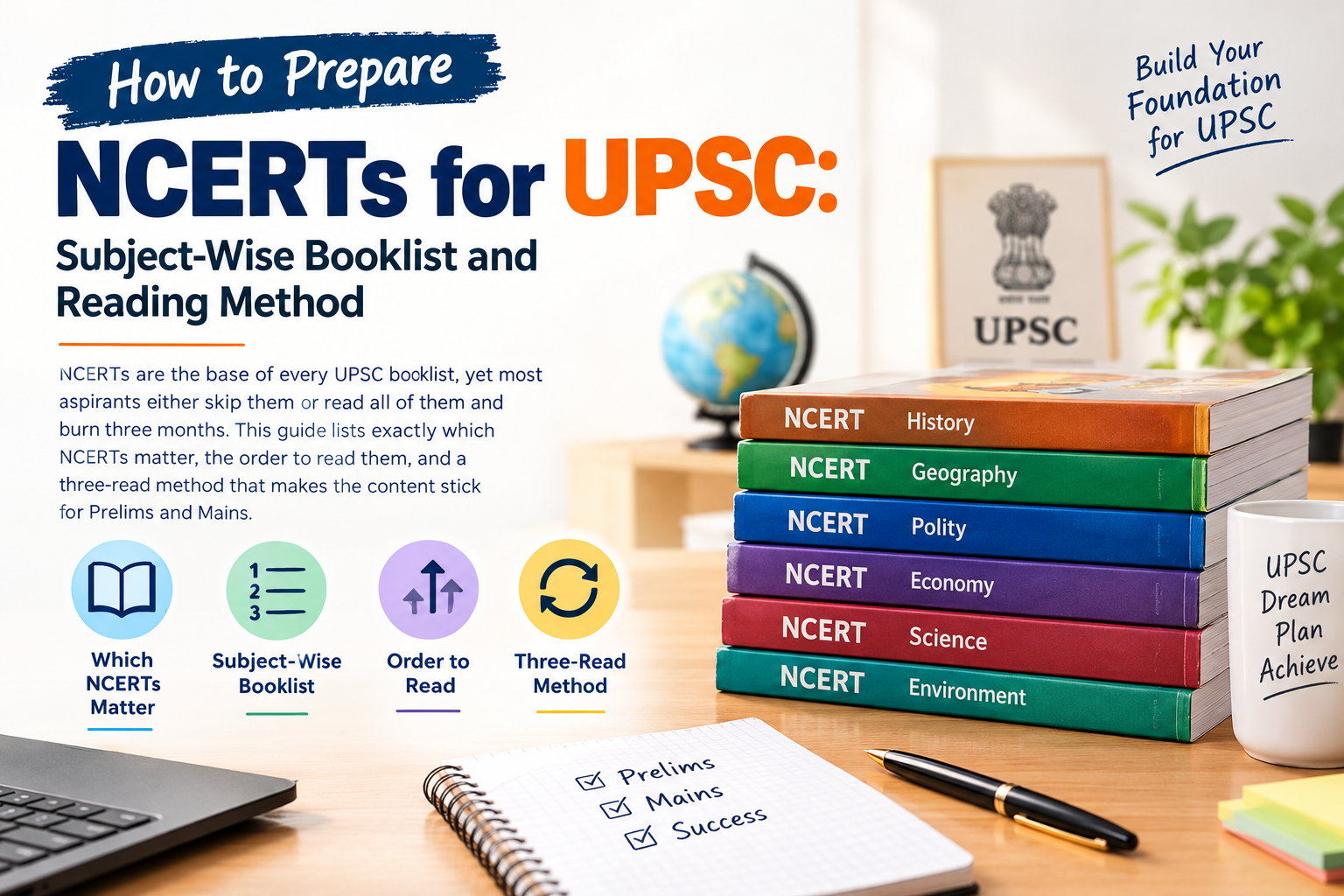
Why NCERTs Work for UPSC
Every UPSC booklist begins with NCERTs, and every year a large number of Prelims questions are answerable directly from them. Yet many aspirants either dismiss them as school books or read every NCERT from Class 6 to 12 in every subject and lose three months on chapters that will never be tested.
- They explain concepts from first principles in plain language, which is exactly what conceptual Prelims questions test
- Question-setters use them as the reference for standard facts and terminology
- The high-yield set can be finished in eight to ten weeks
- They make standard books easier: Laxmikanth is far simpler after Class 11 Polity
Subject-Wise NCERT Booklist for UPSC
| Subject | Must-read NCERTs | Optional or skim |
|---|---|---|
| Geography | Class 11: Fundamentals of Physical Geography; India Physical Environment. Class 12: Fundamentals of Human Geography; India People and Economy | Class 6 to 10 for basics if you have no background |
| History | Class 12: Themes in Indian History Parts I, II and III | Class 6 to 8 Our Pasts for chronology; old NCERTs by R.S. Sharma, Satish Chandra and Bipan Chandra for depth |
| Polity | Class 11: Indian Constitution at Work. Class 12: Politics in India Since Independence | Class 9 and 10 Democratic Politics |
| Economy | Class 11: Indian Economic Development. Class 12: Introductory Macroeconomics | Class 12 Microeconomics, selected chapters only |
| Science | Class 6 to 10 Science; Class 12 Biology chapters on ecology, biodiversity and biotechnology | Class 11 Biology for human health basics |
| Society | Class 12: Indian Society; Social Change and Development in India | Class 11 Introducing Sociology |
| Art and Culture | Class 11: An Introduction to Indian Art | Class 12 Craft Traditions of India |
The Reading Order That Front-Loads Prelims Marks
- Geography Class 11 and 12, with an atlas open at all times
- History Class 12 Themes, all three parts
- Polity Class 11, then Class 9 and 10 for gaps
- Economy Class 11 and 12
- Science Class 6 to 10, then the Biology environment chapters
- Society Class 12
- Art Class 11
This order covers the subjects with the highest Prelims weight first and builds the base for the standard books you will read next.
The Three-Read Method
Reading an NCERT once is not preparation. The method below takes a chapter from first read to exam-ready.
First Read: For Understanding
Read the chapter as a story. Do not underline and do not make notes. The goal is to understand the flow and the concepts. Pace: 30 to 45 minutes per chapter.
Second Read: For Keywords and Testing
Read with a pencil. Underline terms, names, dates, definitions and any sentence that could become a statement-based question. After the chapter, solve 15 to 25 MCQs on it. Wrong answers point to lines you underlined but did not absorb. Pace: 45 to 60 minutes including MCQs.
Third Read: Keyword Recall Weeks Later
Do not reopen the chapter. Look at your underlined keywords or a keyword list and try to recall the surrounding fact. Cover the answer, test yourself, then reveal. This active recall is where retention happens; passive re-reading feels productive and is not.
Notes from NCERTs: Keep Them Short or Skip Them
NCERTs are already concise. Long notes duplicate the book. Instead, keep a one-page keyword list per chapter: terms, figures, names and one-line definitions. This becomes your revision tool in the last month before Prelims, when there is no time to open books.
NCERTs for Mains
NCERTs also supply the vocabulary and balanced framing that GS answers need. Class 12 Indian Society is a direct source for GS Paper I society questions. Class 11 Indian Constitution at Work gives clean definitions for GS Paper II. Class 12 Politics in India Since Independence is the best single source for post-independence consolidation questions.
Pair Every NCERT Chapter with Previous Year Questions
The fastest way to read an NCERT chapter at the right depth is to see how UPSC has tested it. Before your second read, attempt the topic-wise PYQs for that chapter from the last ten years. You will notice three things:
- Which lines in the chapter have been turned into statement-based questions
- How much detail UPSC expects, which is usually less breadth and more precision than aspirants assume
- Where the chapter connects to current affairs, for example Class 11 Physical Geography and monsoon news, or Class 12 Biology ecology and climate conventions
Repeat the same PYQs after the second read. The jump in score is the most reliable evidence that your reading is working.
NCERTs for State PCS Exams
The same NCERT set serves UPPCS, BPSC, MPPCS and other State PCS exams, which draw even more directly from NCERT facts in their Prelims. Two additions matter for state exams:
- Read the state-specific chapters of Class 9 and 10 Geography and Economy for regional agriculture, minerals and drainage, which state papers ask in detail
- Give Ancient and Medieval History from Class 6 to 8 and Class 12 Themes Part I and II more weight, because state Prelims papers ask more factual history questions than UPSC does
If you are preparing for UPSC and a State PCS together, finish the common NCERT set first and add the state-specific material in the last two months before the state Prelims.
Common Mistakes with NCERTs
- Reading all NCERTs from Class 6 to 12 in every subject before starting anything else
- Skipping NCERTs entirely and starting with Laxmikanth or Spectrum
- Making 30-page notes from a 20-page chapter
- Reading without solving MCQs afterwards
- Reading both new and old editions in full for the same subject
Read, Test and Recall NCERTs with IAS Ladder
IAS Ladder is built for the three-read method. Chapter-wise NCERT notes with highlighted keywords, Recall Mode that hides keywords so you can test yourself at Easy, Medium or Hard level, and chapter-wise MCQs to attempt right after reading, all in English and Hindi. Download IAS Ladder and finish your NCERTs the way they should be finished.
Practicing UPSC Prelims PYQs?
Practice 45+ years of topic-wise previous year questions (1979–2026) with in-depth explanations on our mobile app.
Never miss a daily update
Join our official Telegram channel or WhatsApp group for daily current affairs and test alerts.
Frequently Asked Questions
Tags
Related Articles
Indian River Systems: Himalayan and Peninsular Rivers
India’s drainage is shaped by relief, rock structure, climate and the history of landforms. Compare Himalayan and Peninsular river systems,…
Mauryan Administration: Structure, Sources and Limits
Explore how the Mauryan Empire governed a large and diverse territory through a royal centre, provincial hubs, officials, revenue systems a…

NCERT Geography for UPSC: A Chapter-Wise Priority List from Class 6 to Class 12
Geography NCERTs run to seven books and about seventy chapters, and they are not equally important. This guide ranks every chapter into thr…
Keep reading
More in UPSC CSE
- NCERT NCERT Polity and History for UPSC: What to Read, What to Skip and What to Extract
- Optional & Subjects Colonial Land Revenue: Permanent, Ryotwari and Mahalwari
- Current Affairs Pumped Storage Hydropower: Energy, Efficiency and the Grid
- Optional & Subjects Constitutional Writs: Articles 32 and 226 Explained
- Current Affairs Khelo India Sports Goods Scheme: Manufacturing and MSMEs
- Current Affairs National Unity Day: Patel, Integration and India’s Union