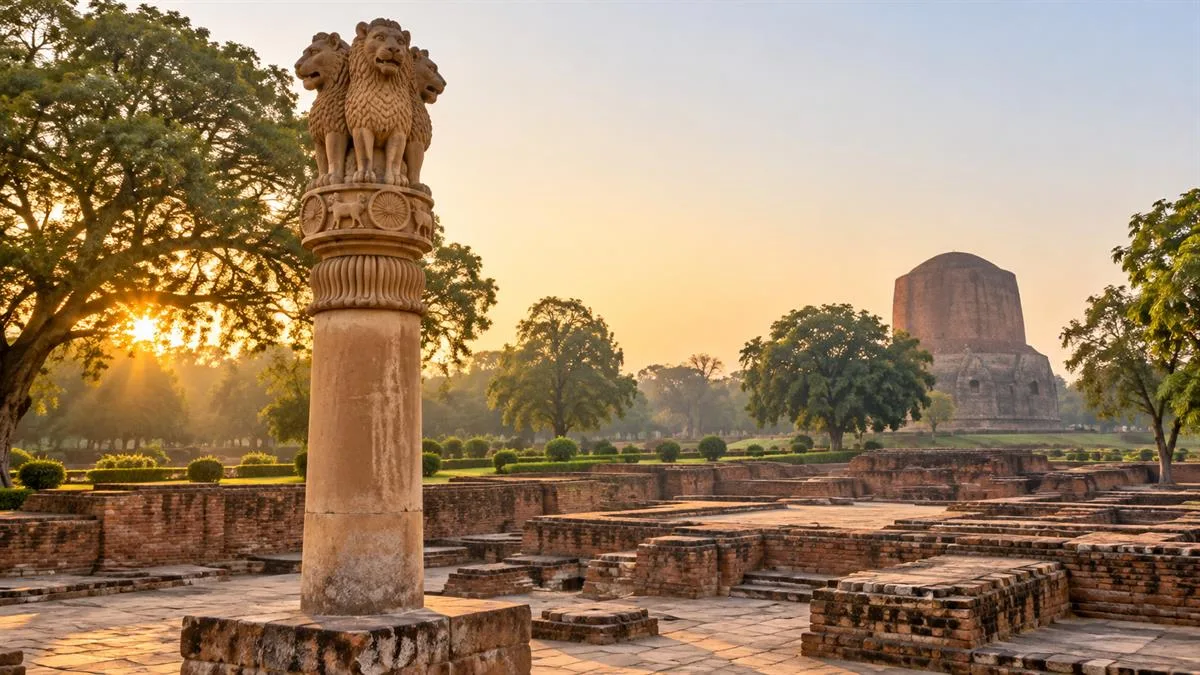
Why study Mauryan administration?
The Mauryan Empire, founded by Chandragupta Maurya in the late fourth century BCE and expanded under his successors, is an important case study in the growth of early states in the subcontinent. Its scale raises a central question for history: how could a ruler coordinate distant regions when travel and communication were slow? The answer was not a modern, uniform bureaucracy. Mauryan rule combined a powerful imperial centre with provincial authorities, local intermediaries, roads, revenue collection, military presence and, under Ashoka, public messages about ethical conduct.
For UPSC CSE and State PCS, the topic connects ancient history with state formation, sources, political geography, economy and the limits of central authority. A strong answer describes both the institutions visible in the evidence and the variation that must have existed across the empire.
What are the sources, and what are their limits?
No single surviving record gives a complete administrative manual for every Mauryan reign. Ashoka’s inscriptions are contemporary royal proclamations, issued in different regions and languages. They name officials, describe the circulation of orders and set out the king’s ideas of dhamma. They are especially valuable because they were placed in public settings, but they express the ruler’s objectives; they do not prove that every instruction was followed everywhere.
Other evidence includes archaeological remains, coins, later literary traditions, the surviving fragments of Megasthenes’ account of the court of Chandragupta, and the Arthashastra, a text associated with Kautilya. Each source has a different purpose and date. Megasthenes was an outside observer whose account survives indirectly. The Arthashastra is a prescriptive treatise with a layered history, so it should not be treated as a verbatim description of every Mauryan practice. Historians compare sources rather than combining every detail into one timeless system.
The imperial centre and the problem of scale
Pataliputra served as the principal political centre. The king and senior advisers stood at the apex of decisions about war, diplomacy, appointments, revenue and public order. The court could issue commands and receive information from officials, but distance imposed practical limits. An order from the centre could not be monitored instantly in the northwest, the Deccan or a frontier zone. Roads, river routes and established towns helped movement, yet the speed and reliability of communication varied by season and terrain.
This is why “centralised empire” should be used carefully. The Mauryas possessed a strong centre and the capacity to mobilise resources on a large scale. That does not mean that every village was administered by identical officials under equally close supervision. The degree of direct control likely differed according to a region’s strategic value, economic importance, distance from the capital and relationship with the ruling power.
Provinces, regional centres and local authority
Inscriptions and historical reconstructions point to important regional centres such as Taxila, Ujjayini, Tosali and Suvarnagiri, alongside Pataliputra. Their positions helped connect the court with northern, western, eastern and southern zones. Princes or senior officials could be placed in provincial roles, though the arrangements were not necessarily the same in every province or reign. Provincial centres were useful for supervising officials, managing revenue and justice, and responding to local conditions.
Below this level, the empire depended on a range of local arrangements. Towns, market centres, villages and frontier communities did not all fit one administrative template. Local headmen, prominent groups and established institutions could help collect dues, convey orders or maintain order. In regions where the imperial presence was less direct, negotiation with local powers mattered. The best answer therefore avoids drawing a neat pyramid in which every level is documented with equal certainty.
Officials, inspection and public communication
Mauryan governance required officials to move information in both directions. Orders had to reach the provinces, while reports about resources, disputes and public conditions had to reach the king. Ashoka’s inscriptions mention several categories of officers. The dhamma-mahamattas, appointed after the Kalinga war according to the king’s own account, were associated with the promotion of dhamma and attention to different social groups. Other named officials were expected to tour, supervise or communicate royal instructions.
These references show an aspiration to make authority visible beyond the court. They also reveal an administrative challenge: a ruler could proclaim a policy, but implementation depended on people who interpreted it in local circumstances. The inscriptions’ repeated instructions to officials suggest that supervision and communication were active concerns, not proof that the state possessed modern paperwork or uniform enforcement.
Revenue, agriculture and the material base of rule
Maintaining a court, officials, roads and an army required resources. Agriculture was central to the economy, and land revenue formed an important part of state income. The actual burden and method of collection could vary with crop, locality, irrigation, custom and political conditions. A general statement that “one fixed share was collected everywhere” oversimplifies the evidence. The state also drew on trade, crafts, forests, mines, tolls and other sources, although their contribution differed across regions.
Revenue was not merely a list of taxes. It linked the state to production, transport and exchange. Routes helped move goods and officials; towns concentrated craft production and markets; access to resources supported political power. At the same time, extracting too much could weaken cultivators and provoke resistance. Mauryan administration therefore depended on balancing the demand for resources with the need to keep agrarian and commercial activity functioning.
Ashoka’s dhamma and the meaning of welfare
Ashoka’s dhamma was a broad ethical and social programme expressed through inscriptions. It stressed respect for parents and teachers, humane treatment of servants, restraint, generosity and consideration for different religious communities. It was not simply another name for Buddhism, nor did the inscriptions present it as a detailed criminal or civil code. Ashoka’s personal association with Buddhism is historically significant, but the public language of dhamma was designed to communicate conduct across a diverse population.
Royal messages referred to measures such as attention to medical care, planting trees, digging wells and providing facilities for travellers. These statements help historians understand how Ashoka wanted kingship to be seen: as responsible for the welfare and moral improvement of subjects. They should be read as evidence of a policy and royal ideal, not as proof that services reached every community equally or that the state replaced local institutions.
Common misconceptions to avoid
- “Every Mauryan region was controlled in the same way.” The centre was powerful, but geography and local relationships shaped the reach of authority.
- “The Arthashastra is a direct record of Mauryan administration.” It is a prescriptive text with a complex composition history; compare it with inscriptions and archaeology.
- “Ashoka’s dhamma was identical to Buddhist doctrine.” His personal faith and the public ethical policy are related but not interchangeable categories.
- “A list of officials proves perfect control.” Names and duties show institutional ambitions, while implementation must be assessed from evidence.
- “A fixed revenue share applied everywhere.” Collection depended on local production, custom and administrative conditions.
How to use the topic in Prelims and Mains
For Prelims, revise the sequence Chandragupta–Bindusara–Ashoka, the role of Pataliputra, the regional centres associated with the empire, the types of evidence and the meaning of dhamma-mahamatta. Be alert to questions that confuse a prescriptive text with an inscription, or Ashoka’s ethical policy with a purely religious decree.
For Mains, organise the answer around the relationship between the imperial centre and regional variation. Explain the evidence first, then discuss provincial administration, officials, revenue and Ashoka’s public communication. A balanced conclusion can note that the Mauryas built a large political structure, but the surviving record supports a differentiated system rather than a uniform modern bureaucracy. State PCS candidates can add the regional significance of Magadha, Pataliputra and nearby archaeological evidence when the question calls for it.
Revision takeaway
Remember the Mauryan state as a strong imperial centre connected to regional hubs and local institutions. In answers, distinguish royal ideals from actual implementation and use inscriptions, literary texts and archaeology according to what each source can establish.
Practicing UPSC Prelims PYQs?
Practice 45+ years of topic-wise previous year questions (1979–2026) with in-depth explanations on our mobile app.
Never miss a daily update
Join our official Telegram channel or WhatsApp group for daily current affairs and test alerts.
Frequently Asked Questions
Test yourself · 10 practice questions
Practice MCQs on Mauryan Administration: Structure, Sources and Limits
Check how well you understood this article with 10 UPSC-style multiple-choice questions — instant answers with detailed explanations.
View all questions with answersTags
Related Articles
Indian River Systems: Himalayan and Peninsular Rivers
India’s drainage is shaped by relief, rock structure, climate and the history of landforms. Compare Himalayan and Peninsular river systems,…

NCERT Geography for UPSC: A Chapter-Wise Priority List from Class 6 to Class 12
Geography NCERTs run to seven books and about seventy chapters, and they are not equally important. This guide ranks every chapter into thr…

NCERT Polity and History for UPSC: What to Read, What to Skip and What to Extract
The Polity and History NCERTs together run to more than a dozen books, and the exam draws on a third of them. This guide goes book by book:…
Keep reading
More in UPSC CSE
- NCERT How to Prepare NCERTs for UPSC: Subject-Wise Booklist and Reading Method
- Optional & Subjects Colonial Land Revenue: Permanent, Ryotwari and Mahalwari
- Current Affairs Pumped Storage Hydropower: Energy, Efficiency and the Grid
- Optional & Subjects Constitutional Writs: Articles 32 and 226 Explained
- Current Affairs Khelo India Sports Goods Scheme: Manufacturing and MSMEs
- Current Affairs National Unity Day: Patel, Integration and India’s Union