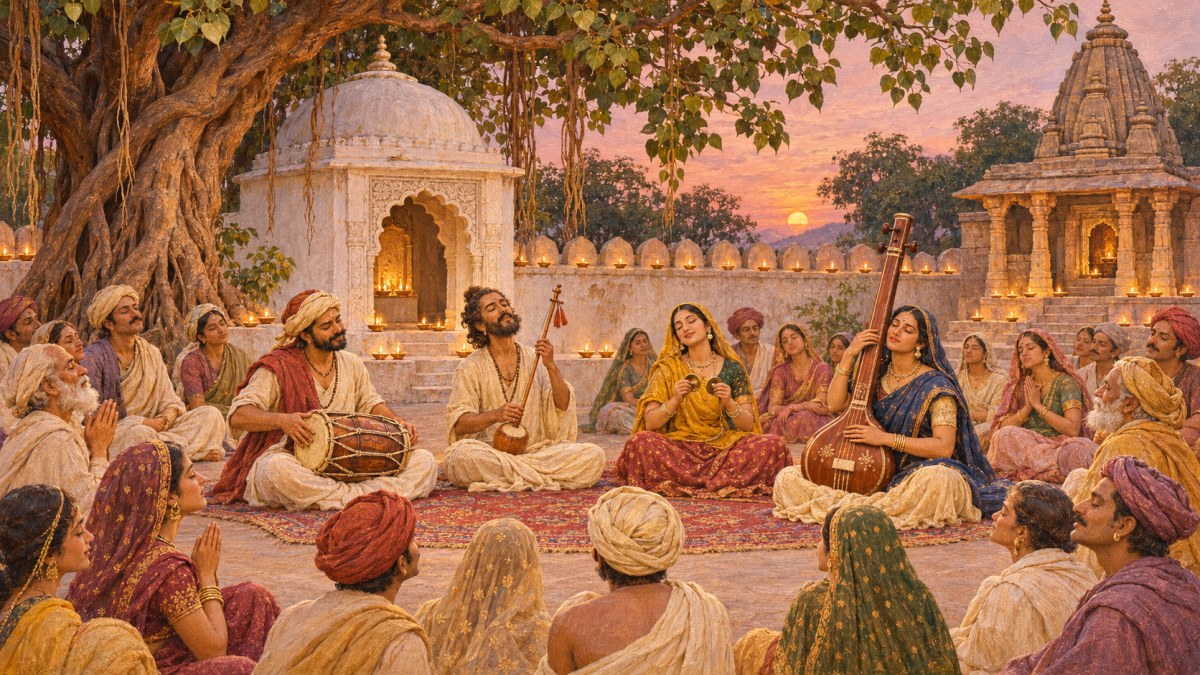
What united Bhakti saints and Sufi mystics?
Between roughly the sixth and seventeenth centuries, devotional movements transformed religious life across the Indian subcontinent. Bhakti saints taught that a personal, loving devotion to God mattered more than ritual, priestly mediation or birth. Sufi mystics within Islam sought closeness to God through love, discipline and the guidance of a spiritual master. Though they came from different traditions, both used the languages of ordinary people, drew followers across castes and classes, and left a rich legacy of poetry, music and shrines.
Prelims questions in this area test precise associations: which saint belonged to which region and period, which philosopher held which doctrine, and what Sufi terms mean. This article organises them so that each fact fits into a clear framework.
The early Bhakti movement in South India
The earliest Bhakti movements emerged in Tamil Nadu between about the sixth and ninth centuries. The Alvars were devotees of Vishnu, and the Nayanars were devotees of Shiva. Traditionally, there are 12 Alvars and 63 Nayanars. They travelled from place to place, composing hymns in Tamil in praise of their deities and associating them with particular shrines.
- The hymns of the Alvars were compiled as the Nalayira Divyaprabandham; the Nayanars' hymns were compiled in the Tevaram.
- Saints came from many social groups, including artisans, cultivators and some regarded as "untouchable".
- Andal, a woman Alvar, and Karaikkal Ammaiyar, a woman Nayanar, are among the most celebrated figures; their compositions challenged the conventions of their time.
Philosophers of devotion
From the eighth century onwards, teachers gave Vedantic philosophy different interpretations. These schools are frequently tested together.
| Teacher | Approximate period | School | Core idea |
|---|---|---|---|
| Shankaracharya | 8th century | Advaita (non-dualism) | The individual soul and Brahman are one; the world as perceived is maya |
| Ramanuja | 11th–12th century | Vishishtadvaita (qualified non-dualism) | The soul is distinct yet inseparable from God; devotion (bhakti) is the best means to salvation |
| Madhvacharya | 13th century | Dvaita (dualism) | God and the individual soul are eternally distinct |
| Vallabhacharya | 15th–16th century | Shuddhadvaita (pure non-dualism) | Devotion to Krishna through divine grace; founded the Pushtimarg |
Virashaiva tradition in Karnataka
In the twelfth century, a movement led by Basavanna, a minister at the Kalachuri court, arose in Karnataka. Its followers, the Virashaivas or Lingayats, worship Shiva in the form of a linga worn on the body. They challenged the idea of caste and the authority of Brahmanical ritual, questioned the theory of rebirth, and encouraged practices disapproved of in the Dharmashastras, such as the remarriage of widows. Their teachings were expressed in short compositions in Kannada called vachanas.
Saguna and nirguna bhakti in North India
Bhakti in North India developed two broad streams. Saguna bhakti worshipped God with attributes and form, especially Rama and Krishna. Nirguna bhakti worshipped an abstract, formless God and rejected idol worship and ritual.
- Kabir (15th century), a weaver, was the leading nirguna saint. He criticised the rituals and orthodoxies of both Hindus and Muslims, and described the Ultimate Reality by many names. His verses are preserved in the Bijak, the Kabir Granthavali and the Guru Granth Sahib. Tradition regards Ramananda as his teacher.
- Guru Nanak (1469–1539) preached devotion to a formless God through remembrance of the divine name, rejecting caste distinctions and ritual. He was preaching when Babur defeated Ibrahim Lodi at Panipat in 1526.
- Mirabai, a Rajput princess, was devoted to Krishna; Surdas composed songs on Krishna, and Tulsidas wrote the Ramcharitmanas in Awadhi.
- Dadu Dayal was a nirguna saint of the sixteenth century, in Akbar's time.
Many saints came from artisan and service communities, and Prelims has tested their professions.
| Saint | Traditional occupation | Region |
|---|---|---|
| Kabir | Weaver | Banaras |
| Ravidas | Cobbler (leatherworker) | Banaras |
| Sena | Barber | North India |
| Namdev | Tailor | Maharashtra |
Regional traditions in Maharashtra and the east
- Maharashtra: the Varkari tradition centred on Vitthala at Pandharpur. Jnaneshwar (13th century) wrote the Jnaneshwari in Marathi; Namdev (13th–14th century), Eknath (16th century) and Tukaram (17th century), known for his abhangas, followed.
- Bengal: Chaitanya (late 15th–early 16th century) popularised devotion to Krishna through ecstatic congregational singing (kirtan).
- Assam: Sankaradeva (15th–16th century) propagated the Ekasarana dharma, devotion to one God (Krishna), through chanting and listening to God's name. His tradition established sattras (monasteries) and namghars (prayer halls), and the Sattriya dance developed within it.
Sufism in India
Sufism was a mystical stream within Islam that emphasised love of God, inner purification and the guidance of a master. In India it became a powerful force from the twelfth century.
| Term | Meaning |
|---|---|
| Khanqah | Hospice where the shaikh (pir) lived with disciples and received visitors |
| Murid | Disciple of the shaikh |
| Silsila | Chain of spiritual succession linking master and disciple back to the Prophet |
| Sama | Musical recitation of mystical poetry to evoke divine ecstasy |
| Zikr | Recitation or remembrance of the names of God |
| Dargah | Shrine built over the grave of a Sufi saint |
| Urs | Annual celebration of a saint's death anniversary, seen as union with God |
Sufis practised meditation and breath control, ascetic exercises in solitude, and recitation of devotional songs to arouse ecstasy, especially through sama.
Major silsilas
- Chishti: the most influential order in India. Khwaja Muinuddin Chishti settled at Ajmer; later masters included Nizamuddin Auliya in Delhi, whose disciples included Nasiruddin Chirag-i-Dehli and the poet Amir Khusrau, and Shaikh Salim Chishti at Fatehpur Sikri in Akbar's time. Early Chishtis generally kept their distance from the court, embraced sama and used local languages.
- Suhrawardi: centred at Multan under Shaikh Bahauddin Zakariya; unlike the Chishtis, they accepted closer relations with the state.
- Naqshbandi: introduced in India by Khwaja Baqi Billah. His disciple Shaikh Ahmad Sirhindi, of the late sixteenth and early seventeenth centuries, opposed liberal practices and stressed orthodoxy.
- Firdausi: associated with Shaikh Sharafuddin Yahya Maneri in Bihar.
The Chishtis' success came largely from adapting to local devotional traditions: they used local languages such as Hindavi, welcomed visitors of all backgrounds, and developed music such as qawwali.
Common confusions and traps
- "The Alvars and Nayanars composed in Sanskrit." Wrong; they composed in Tamil.
- "Madhva taught Shuddhadvaita." Wrong; Madhva taught Dvaita, while Shuddhadvaita belongs to Vallabhacharya.
- "Kabir was influenced by Shaikh Ahmad Sirhindi." Wrong; Sirhindi lived about a century after Kabir and represented Sufi orthodoxy.
- "Lingayats upheld caste and Vedic ritual." Wrong; they challenged both.
- "Sattriya dance belongs to the Varkari tradition." Wrong; it developed in Sankaradeva's tradition in Assam.
- "Silsila means a Sufi shrine." Wrong; it is a chain of succession; the shrine is a dargah.
- "Nagarjuna was a Bhakti saint." Wrong; he was a Buddhist philosopher of the Madhyamaka school.
How the theme appears in UPSC Prelims
UPSC Prelims has repeatedly drawn on this area. Questions have asked about the professions of Bhakti saints (2001), Sufi figures and their contemporaries (2002), the chronological order of Shankaracharya, Ramanuja and Chaitanya (2004), who was not a proponent of bhakti (2010), Sufi practices (2012), which saints were preaching when the Lodi dynasty fell (2013), whether Kabir was influenced by Sirhindi (2019), and the teachings of Ramanuja (2022). The pattern rewards placing each saint correctly in time, region and doctrine.
Quick revision points
- Alvars (Vishnu) and Nayanars (Shiva): Tamil hymns, 6th–9th centuries; Andal and Karaikkal Ammaiyar.
- Advaita: Shankara; Vishishtadvaita: Ramanuja; Dvaita: Madhva; Shuddhadvaita and Pushtimarg: Vallabhacharya.
- Basavanna: Virashaiva movement, 12th-century Karnataka; vachanas; rejected caste.
- Nirguna: Kabir, Guru Nanak, Dadu; saguna: Mirabai, Surdas, Tulsidas.
- Kabir weaver, Ravidas cobbler, Sena barber, Namdev tailor.
- Jnaneshwar, Namdev, Eknath, Tukaram: Varkari tradition of Maharashtra.
- Sankaradeva: Ekasarana dharma, sattras, namghars, Sattriya dance.
- Sufi terms: khanqah, silsila, sama, zikr, dargah, urs; Chishti, Suhrawardi, Naqshbandi, Firdausi.
Practise next: Attempt related MCQs and revise quick notes on this topic in the IASLadder app.
Practicing UPSC Prelims PYQs?
Practice 45+ years of topic-wise previous year questions (1979–2026) with in-depth explanations on our mobile app.
Never miss a daily update
Join our official Telegram channel or WhatsApp group for daily current affairs and test alerts.
Frequently Asked Questions
Test yourself · 10 practice questions
Practice MCQs on Bhakti and Sufi Movements: Saints, Philosophies and Silsilas
Check how well you understood this article with 10 UPSC-style multiple-choice questions — instant answers with detailed explanations.
View all questions with answersTags
Related Articles
Directive Principles of State Policy: Articles 36 to 51 Explained
Part IV of the Constitution sets out the Directive Principles of State Policy. This guide explains each Article from 36 to 51, their classi…
RBI Monetary Policy Tools: Repo, CRR, SLR, OMOs and the MPC
How does the RBI change the cost and quantity of money? This guide explains inflation targeting, the Monetary Policy Committee, the repo–SD…
India's Three-Stage Nuclear Programme: Reactors, Fuels and Thorium
India has little uranium but vast thorium, which cannot run a reactor on its own. This guide explains fission, moderators and coolants, fis…
Keep reading
More in Optional & Subjects
- Optional & Subjects Protected Areas in India: National Parks, Sanctuaries and Reserves
- Optional & Subjects Temple Architecture: Nagara, Dravida and Vesara Styles
- Optional & Subjects Groundwater and Aquifers: Recharge, Pumping and Water Security
- Optional & Subjects Balance of Payments: Current Account, Capital Flows and Reserves
- Optional & Subjects Colonial Land Revenue: Permanent, Ryotwari and Mahalwari
- Optional & Subjects Constitutional Writs: Articles 32 and 226 Explained