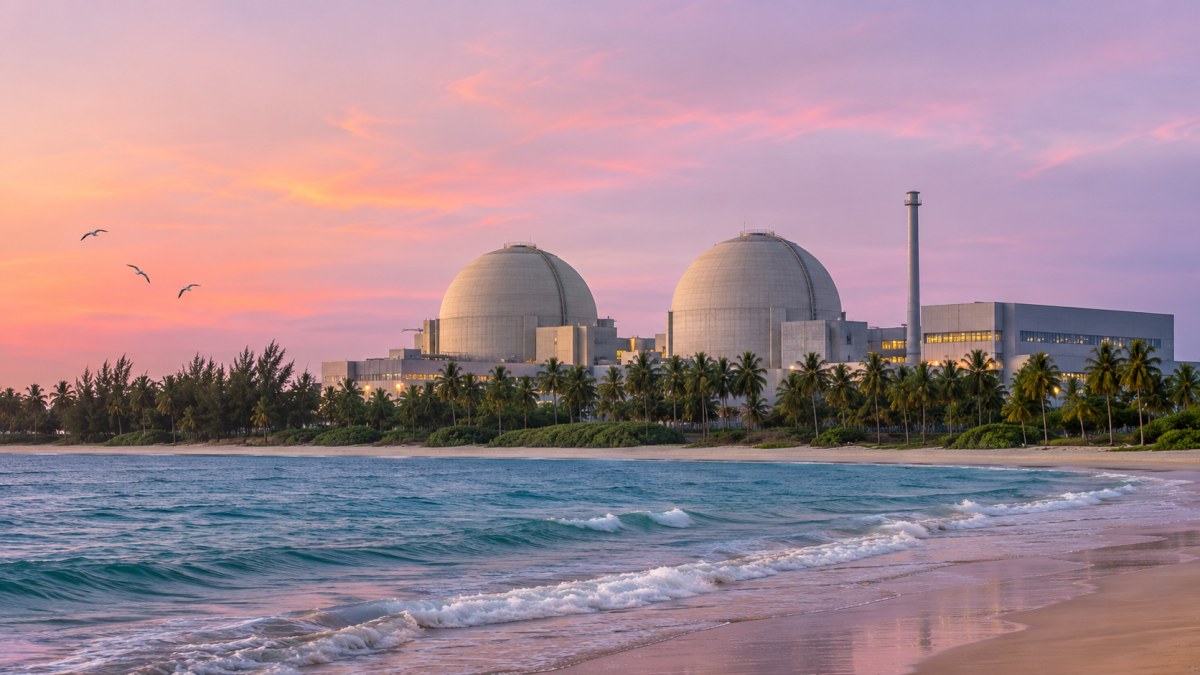
Why did India choose a three-stage path to nuclear power?
India has modest reserves of uranium, mostly low grade, but among the largest reserves of thorium in the world. Thorium, however, cannot sustain a chain reaction by itself. India's three-stage nuclear power programme, formulated by Homi J. Bhabha in the 1950s, is a plan to convert this mismatch into long-term energy security: use limited uranium first, multiply the fissile material in breeder reactors, and finally run reactors on thorium.
The programme reached an important milestone on 6 April 2026, when the 500 MWe Prototype Fast Breeder Reactor (PFBR) at Kalpakkam in Tamil Nadu attained first criticality. To understand why this matters, one has to start with how a reactor works.
Reactor basics: the terms that decide most questions
In nuclear fission, a heavy nucleus such as uranium-235 absorbs a neutron and splits into two lighter nuclei, releasing energy and two or three new neutrons. If, on average, at least one of these neutrons causes another fission, the reaction becomes self-sustaining. A reactor is said to attain criticality when this chain reaction first becomes self-sustaining. Criticality is not the same as generating electricity; power production and grid connection come later.
| Component | Function | Common materials |
|---|---|---|
| Fuel | Contains fissile material that sustains the chain reaction | Natural uranium, enriched uranium, plutonium–uranium mixed oxide |
| Moderator | Slows down fast neutrons so that they cause fission in uranium-235 more efficiently | Heavy water, light (ordinary) water, graphite |
| Coolant | Carries heat from the core to produce steam | Heavy water, light water, liquid sodium |
| Control rods | Absorb neutrons to control or stop the reaction | Boron, cadmium |
Fissile and fertile materials
- Fissile materials can sustain a chain reaction: uranium-235, plutonium-239 and uranium-233.
- Fertile materials cannot sustain a chain reaction but can be converted into fissile material by absorbing a neutron: uranium-238 becomes plutonium-239, and thorium-232 becomes uranium-233.
Natural uranium contains only about 0.7 per cent uranium-235; the rest is mostly uranium-238. Thorium is entirely fertile. This single fact explains the entire design of India's programme.
Enrichment
Light water reactors need uranium enriched to about 3–5 per cent uranium-235. India's pressurised heavy water reactors (PHWRs), by contrast, run on natural uranium because heavy water absorbs very few neutrons, leaving enough to sustain the chain reaction. Very high enrichment, around 90 per cent, is associated with weapons, not with power generation.
The three stages
| Stage | Reactor type | Fuel | What it produces for the next stage |
|---|---|---|---|
| Stage I | Pressurised Heavy Water Reactors (PHWRs) | Natural uranium; heavy water as moderator and coolant | Plutonium-239, recovered by reprocessing spent fuel |
| Stage II | Fast Breeder Reactors (FBRs) | Plutonium–uranium mixed oxide; liquid sodium coolant; no moderator | More plutonium from a uranium-238 blanket; later uranium-233 from a thorium blanket |
| Stage III | Thorium-based reactors | Thorium-232 with uranium-233 | Self-sustaining thorium–uranium-233 cycle |
Stage I: PHWRs
PHWRs form the backbone of India's nuclear fleet. They burn natural uranium, so India does not need enrichment for them. Part of the uranium-238 in the fuel absorbs neutrons and turns into plutonium-239, which is separated from spent fuel by reprocessing. India has standardised and scaled up the design, from 220 MWe units to indigenous 700 MWe units.
Stage II: Fast Breeder Reactors
A fast reactor uses fast neutrons, so it needs no moderator. Water would slow neutrons down, so the coolant must be a material such as liquid sodium, which removes heat efficiently without moderating them. The core uses plutonium-rich fuel and is surrounded by a blanket of fertile material. A breeder reactor produces more fissile material than it consumes. In the early part of Stage II, a uranium-238 blanket breeds plutonium to grow the fleet; thorium is then introduced in the blanket to breed uranium-233 for Stage III.
India's experience with fast reactors began with the Fast Breeder Test Reactor (FBTR) at the Indira Gandhi Centre for Atomic Research, Kalpakkam. The PFBR, built by Bharatiya Nabhikiya Vidyut Nigam Limited (BHAVINI), is the first commercial-scale step.
Stage III: Thorium
In the final stage, reactors would use thorium with uranium-233, the fissile material bred in Stage II, continuously converting more thorium into fuel. The Advanced Heavy Water Reactor design is intended to demonstrate thorium use. This stage depends on building up a large enough stock of fissile material through Stage II, which is why the breeder programme is the bridge to thorium.
Resources and institutions
- India's thorium occurs mainly in monazite in the beach sands of Kerala, Tamil Nadu, Odisha and Andhra Pradesh. Monazite is also a source of rare earths, and its mining and processing are reserved for Government entities.
- Uranium is mined by the Uranium Corporation of India Limited at sites such as Jaduguda in Jharkhand and Tummalapalle in Andhra Pradesh. Indian ore is generally low grade.
- Bodies under the Department of Atomic Energy include the Bhabha Atomic Research Centre, the Indira Gandhi Centre for Atomic Research, the Atomic Minerals Directorate for Exploration and Research, the Heavy Water Board, Indian Rare Earths Limited, the Nuclear Power Corporation of India Limited and BHAVINI.
| Plant | State | Reactor type |
|---|---|---|
| Tarapur (Units 1 and 2) | Maharashtra | Boiling Water Reactors, India's first nuclear power units |
| Rawatbhata, Kaiga, Kakrapar, Narora, Kalpakkam (Madras) | Rajasthan, Karnataka, Gujarat, Uttar Pradesh, Tamil Nadu | PHWRs |
| Kudankulam | Tamil Nadu | Light water reactors (VVER) built with Russian cooperation |
| PFBR, Kalpakkam | Tamil Nadu | Sodium-cooled fast breeder reactor |
Safeguards: why some reactors are inspected and others are not
Following the India–United States civil nuclear understanding, India separated its civilian and strategic facilities and signed an India-specific safeguards agreement with the International Atomic Energy Agency (IAEA). The Nuclear Suppliers Group granted India a waiver in 2008, allowing it to import nuclear fuel and technology. Reactors that India places under safeguards, including those running on imported uranium, are open to IAEA inspection, which verifies that the material is not diverted to weapons. India also ratified an Additional Protocol in 2014, which gives the IAEA broader access to information about its civilian programme; it does not bring military facilities under inspection.
Common confusions and traps
- "Heavy water cools the reactor, so that is its main role." Heavy water in a PHWR is both moderator and coolant, but questions on its distinctive function point to moderation: slowing neutrons.
- "Thorium can be used directly as reactor fuel." Wrong; thorium-232 is fertile and must be converted into uranium-233.
- "Power reactors need uranium enriched to 60 per cent or more." Wrong; PHWRs use natural uranium and light water reactors use about 3–5 per cent.
- "Fast breeder reactors use a moderator." Wrong; they deliberately avoid moderation.
- "Criticality means the reactor is supplying electricity." Wrong; it marks the start of a self-sustaining chain reaction.
- "India's reactors are all under IAEA safeguards." Wrong; only those it places under safeguards, such as reactors using imported fuel.
- "Fusion (ITER) and thorium are the same route." Wrong; ITER is about fusion, while thorium belongs to fission.
How the theme appears in UPSC Prelims
UPSC Prelims has examined this topic repeatedly. Questions have asked about the function of heavy water in a reactor (2011), the advantages of thorium over uranium (2012), India's role in the International Thermonuclear Experimental Reactor (2016), the implication of ratifying the Additional Protocol with the IAEA (2018), why some Indian reactors are under IAEA safeguards (2020), monazite and thorium (2022), and whether uranium must be enriched to at least 60 per cent for electricity (2023). An older question (2003) tested liquid sodium as a reactor coolant. The pattern rewards conceptual understanding of fuel, moderator, coolant and safeguards rather than plant-wise facts.
Current connection
- PFBR criticality (6 April 2026): India's entry into commercial-scale Stage II, after a long delay. Its success is a precondition for the planned follow-on fast reactors at Kalpakkam.
- SHANTI Act, 2025: enacted in December 2025, it replaced the Atomic Energy Act, 1962 and the Civil Liability for Nuclear Damage Act, 2010. It allows private Indian companies to build, own and operate nuclear power plants, while sensitive activities remain with the Central Government, and it revises the nuclear liability framework.
- Capacity and targets: India's installed nuclear capacity was about 8.78 GW in mid-2026, and the target is 100 GW by 2047. The 2025-26 Union Budget launched a Nuclear Energy Mission with ₹20,000 crore for research on small modular reactors.
Quick revision points
- Stage I: PHWRs, natural uranium, heavy water moderator and coolant, produce plutonium.
- Stage II: fast breeders, plutonium fuel, sodium coolant, no moderator, breed fissile material.
- Stage III: thorium with uranium-233.
- Fissile: U-235, Pu-239, U-233; fertile: U-238, Th-232.
- Moderator slows neutrons; control rods absorb them.
- Thorium in monazite; processing reserved for Government entities.
- PFBR (500 MWe, Kalpakkam) first criticality on 6 April 2026.
- IAEA safeguards apply only to facilities India places under them.
Practise next: Attempt related MCQs and revise quick notes on this topic in the IASLadder app.
Practicing UPSC Prelims PYQs?
Practice 45+ years of topic-wise previous year questions (1979–2026) with in-depth explanations on our mobile app.
Never miss a daily update
Join our official Telegram channel or WhatsApp group for daily current affairs and test alerts.
Frequently Asked Questions
Test yourself · 10 practice questions
Practice MCQs on India's Three-Stage Nuclear Programme: Reactors, Fuels and Thorium
Check how well you understood this article with 10 UPSC-style multiple-choice questions — instant answers with detailed explanations.
View all questions with answersTags
Related Articles

Directive Principles of State Policy: Articles 36 to 51 Explained
Part IV of the Constitution sets out the Directive Principles of State Policy. This guide explains each Article from 36 to 51, their classi…
Bhakti and Sufi Movements: Saints, Philosophies and Silsilas
From the Alvars and Nayanars to Kabir, Basavanna and Sankaradeva, and from Chishti khanqahs to sama and urs, this guide organises the Bhakt…
RBI Monetary Policy Tools: Repo, CRR, SLR, OMOs and the MPC
How does the RBI change the cost and quantity of money? This guide explains inflation targeting, the Monetary Policy Committee, the repo–SD…
Keep reading
More in Optional & Subjects
- Optional & Subjects Temple Architecture: Nagara, Dravida and Vesara Styles
- Optional & Subjects Groundwater and Aquifers: Recharge, Pumping and Water Security
- Optional & Subjects Balance of Payments: Current Account, Capital Flows and Reserves
- Optional & Subjects Colonial Land Revenue: Permanent, Ryotwari and Mahalwari
- Optional & Subjects Constitutional Writs: Articles 32 and 226 Explained
- Optional & Subjects Ocean Currents, Upwelling and Climate: A Conceptual Guide