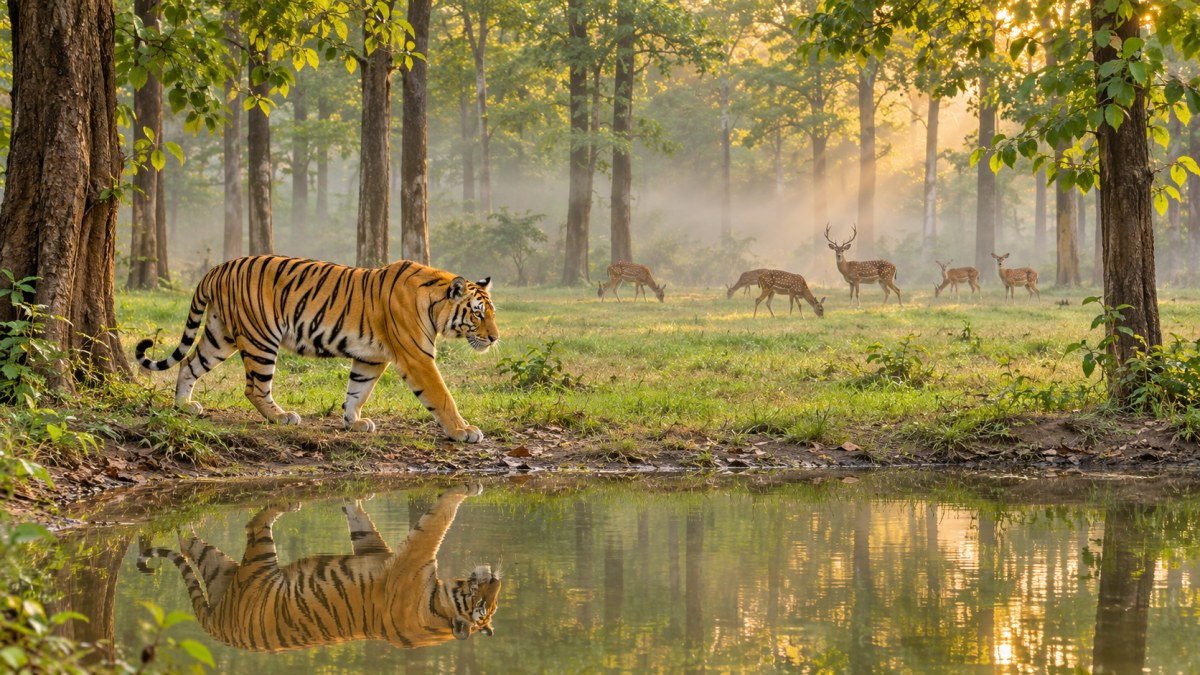
Protected areas in India: one law, several categories
India has more than a thousand protected areas covering a little over five per cent of its geographical area. Under the Wild Life (Protection) Act, 1972, only four of these are legal categories of protected area: Wildlife Sanctuaries, National Parks, Conservation Reserves and Community Reserves. Tiger Reserves are a further layer notified under the same Act. Biosphere Reserves and Eco-Sensitive Zones, though often listed alongside them, rest on entirely different foundations.
Most Prelims errors in this area come from mixing up three things: who declares an area, what rights survive inside it, and who must approve a change to its boundaries. This article sorts out each category on these three questions.
The legal map at a glance
| Category | Legal basis | Declared by | Key feature |
|---|---|---|---|
| Wildlife Sanctuary | Wild Life (Protection) Act, Sections 18–34 | State Government (Central Government for areas under its control, Section 38) | Some rights of local people may continue; grazing can be regulated |
| National Park | Wild Life (Protection) Act, Section 35 | State Government (Central Government under Section 38) | Rights extinguished; no grazing |
| Conservation Reserve | Wild Life (Protection) Act, Section 36A | State Government after consulting local communities | Government-owned land, often buffers and corridors |
| Community Reserve | Wild Life (Protection) Act, Section 36C | State Government where a community or individual volunteers | Private or community land |
| Tiger Reserve | Wild Life (Protection) Act, Section 38V | State Government on the recommendation of the National Tiger Conservation Authority | Inviolate core plus a buffer |
| Biosphere Reserve | No statutory basis; a national scheme linked to UNESCO's Man and the Biosphere Programme | Central Government | Core, buffer and transition zones |
| Eco-Sensitive Zone | Environment (Protection) Act, 1986 | Union Ministry of Environment, Forest and Climate Change | Regulates activity around protected areas |
Wildlife Sanctuary and National Park: the core distinction
Both are declared by the State Government for an area of adequate ecological, faunal, floral, geomorphological, natural or zoological significance. Under Section 38, the Central Government can also declare a sanctuary or National Park over an area under its control. The difference lies in how much human use the law tolerates after declaration.
Rights of local people
Before a final notification, a Collector inquires into claims over land inside the proposed area. For a sanctuary, Section 24(2)(c) allows the Collector, in consultation with the Chief Wild Life Warden, to let certain rights continue within the sanctuary. For a National Park, Section 35(3) applies the same inquiry procedure but expressly excludes Section 24(2)(c). Rights must therefore be acquired or extinguished, and the land vests in the State Government before the park is finally notified.
This single exclusion explains why a National Park is described as a stricter category. It also explains why local people cannot collect and use biomass in a National Park, while a sanctuary may allow continuing rights.
Grazing
- Sanctuary: Under Section 33(d), the Chief Wild Life Warden may regulate, control or prohibit the grazing or movement of livestock in the interest of wildlife. Grazing is therefore possible but controlled.
- National Park: Section 35(7) states that no grazing of any livestock is permitted. Livestock may enter only when used as a vehicle by an authorised person.
Removal of wildlife and forest produce
In both categories, no person may destroy, exploit or remove wildlife, including forest produce, or damage or divert habitat or the flow of water, except under a permit from the Chief Wild Life Warden. Such a permit requires the State Government to be satisfied, in consultation with the National Board for Wild Life, that the action is necessary for better wildlife management. Produce so removed may meet the personal bona fide needs of people living in and around the area, but cannot be used commercially.
Altering boundaries
For both sanctuaries and National Parks, the State Government can alter boundaries only on the recommendation of the National Board for Wild Life, which is chaired by the Prime Minister. Before the 2003 amendment, altering the boundary of a protected area required a resolution of the State Legislature. Aspirants who studied older material often carry this outdated rule into the exam hall.
Other points worth noting
- A National Park may be constituted over an area whether or not it already lies within a sanctuary. Many National Parks began as sanctuaries.
- A sanctuary may include part of the territorial waters. The State Government then needs the Central Government's prior concurrence, and the limits are fixed in consultation with the Chief Naval Hydrographer. Innocent passage of vessels is not affected, and the occupational interests of local fishermen must be protected.
- Commercial tourist lodges, hotels, zoos and safari parks inside a sanctuary or National Park need the prior approval of the National Board for Wild Life.
Conservation Reserves and Community Reserves
These two categories were added by the 2002 amendment to the Act, which came into force in 2003. They filled a gap: large areas of ecological value were neither strict protected areas nor safe from degradation.
| Feature | Conservation Reserve (Section 36A) | Community Reserve (Section 36C) |
|---|---|---|
| Land | Government-owned land, particularly areas adjacent to National Parks and sanctuaries and areas linking one protected area with another | Private or community land not within a National Park, sanctuary or Conservation Reserve |
| Trigger | State Government, after consulting local communities | A community or an individual volunteers to conserve wildlife and its habitat |
| Declared by | State Government (prior concurrence of the Central Government if its land is included) | State Government |
| Purpose | Protecting landscapes, seascapes, flora, fauna and habitat | Protecting fauna, flora and traditional or cultural conservation values and practices |
| Management | Conservation Reserve Management Committee | Community Reserve Management Committee |
In a Community Reserve, no change in the land-use pattern is allowed after notification except through a resolution of the management committee approved by the State Government. The defining features are therefore voluntary initiative, community or private land, and declaration by the State Government. A statement claiming that the Central Government notifies Community Reserves is a classic trap.
Tiger Reserves: a layer over existing protected areas
Chapter IV-B, inserted in 2006, created the National Tiger Conservation Authority (NTCA), a statutory body chaired by the Union Minister in charge of Environment and Forests. Under Section 38V, the State Government notifies a Tiger Reserve on the recommendation of the NTCA and prepares a Tiger Conservation Plan.
| Zone | What the law says | Consultation |
|---|---|---|
| Core or critical tiger habitat | Areas of a National Park or sanctuary to be kept inviolate for tiger conservation, identified on scientific and objective criteria | Expert Committee; rights of Scheduled Tribes and other forest dwellers must not be affected |
| Buffer or peripheral area | Less intense protection; supports tiger dispersal and coexistence with local livelihoods and cultural rights | Gram Sabha concerned and an Expert Committee |
Scheduled Tribes and other forest dwellers cannot be resettled to create inviolate areas, except through voluntary relocation on mutually agreed terms. Otherwise the law sets a series of conditions, including completion of rights recognition, a finding that coexistence is not possible, a livelihood-based rehabilitation package, and the informed consent of the Gram Sabha and affected persons.
Under Section 38W, a Tiger Reserve's boundaries can be altered only on the NTCA's recommendation with the approval of the National Board for Wild Life. A State Government can de-notify a Tiger Reserve only in the public interest, with the approval of both bodies. India has 58 Tiger Reserves. The most recent is Madhav Tiger Reserve in Madhya Pradesh, notified in March 2025. Madhya Pradesh has the largest number.
Biosphere Reserves: conservation with people
A Biosphere Reserve is not a category under the Wild Life (Protection) Act. The idea comes from UNESCO's Man and the Biosphere (MAB) Programme, launched in 1971, which aims to combine biodiversity conservation with sustainable use by people. India designates Biosphere Reserves under a national scheme; the first was the Nilgiri Biosphere Reserve in 1986. India now has 18 Biosphere Reserves.
- Core zone: legally protected and minimally disturbed; usually consists of a National Park or sanctuary already notified under the Act.
- Buffer zone: surrounds the core; research, education and limited activities compatible with conservation.
- Transition zone: the outer area where settlements, farming and sustainable resource use continue in cooperation with local people.
A Biosphere Reserve protects an entire ecosystem, not a few chosen species. Since it combines conservation with traditional human life, it is the protected-area concept best suited to that combination. Inclusion in UNESCO's World Network of Biosphere Reserves is international recognition; it does not create new legal restrictions in India. Thirteen of India's Biosphere Reserves are in this network. The latest is the Cold Desert Biosphere Reserve in Himachal Pradesh, added in September 2025, India's first high-altitude cold desert site in the network.
Eco-Sensitive Zones: shock absorbers around protected areas
Eco-Sensitive Zones (ESZs) are notified by the Union Ministry of Environment, Forest and Climate Change under the Environment (Protection) Act, 1986, not under the Wild Life (Protection) Act. They act as transition belts around protected areas. Under the 2011 guidelines, activities in an ESZ are classed as prohibited (such as commercial mining), regulated, or permitted, and the width of a zone can vary from site to site.
In June 2022, the Supreme Court directed that every protected area should have a minimum ESZ of one kilometre. In April 2023, the Court modified that order: the one-kilometre rule does not apply where the ministry has already issued draft or final ESZ notifications, and the 2011 guidelines govern activities in these zones. The Court said a blanket rule could hamper the daily lives of local residents and intensify human–wildlife conflict. ESZs therefore regulate rather than ban; the idea that only agriculture is allowed there is wrong.
Common confusions and traps
- "Biosphere Reserves are declared under the Wild Life (Protection) Act." Wrong; they rest on a national scheme linked to UNESCO's MAB Programme.
- "Eco-Sensitive Zones are declared under the Wild Life (Protection) Act." Wrong; they are notified under the Environment (Protection) Act, 1986.
- "A National Park's boundary can be altered only by the State Legislature." Outdated; since 2003 the State Government acts on the National Board for Wild Life's recommendation.
- "The Central Government notifies Community Reserves." Wrong; the State Government does, where people volunteer.
- "Critical tiger habitat is the buffer." Reversed; it is the inviolate core.
- "Botanical gardens are in-situ conservation." Wrong; they are ex-situ. Sanctuaries, National Parks and Biosphere Reserves are in-situ.
- "UNESCO recognition gives a site legal protection." Wrong; legal protection comes from Indian law.
How the theme appears in UPSC Prelims
UPSC Prelims has repeatedly examined this area from two directions. Conceptual questions have asked which category bars local people from using biomass (2012), which strategy best combines biodiversity conservation with traditional human life (2014), whether Eco-Sensitive Zones are declared under the Wild Life (Protection) Act (2014), what follows once an area becomes a Community Reserve (2023), and whether a National Park's boundaries are defined by legislation (2010). Location questions have covered individual parks and reserves, such as the Desert National Park (2020), the tiger reserve with the largest critical tiger habitat (2020), and Madhav National Park (2026). Understanding the legal framework helps eliminate options even in location questions.
Quick revision points
- Four protected-area categories under the Act: Sanctuary, National Park, Conservation Reserve, Community Reserve.
- National Park: rights extinguished (Section 24(2)(c) excluded), no grazing.
- Sanctuary: some rights may continue; grazing regulated by the Chief Wild Life Warden.
- Boundary changes: State Government on the National Board for Wild Life's recommendation.
- Conservation Reserve: government land, corridors; Community Reserve: private or community land, voluntary.
- Tiger Reserve: State Government on NTCA's recommendation; core inviolate, buffer with Gram Sabha consultation; 58 reserves.
- Biosphere Reserve: MAB-based, no statutory basis; 18 in India, 13 in UNESCO's network.
- ESZ: Environment (Protection) Act, 1986; activities prohibited, regulated or permitted.
Practise next: Attempt related MCQs and revise quick notes on this topic in the IASLadder app.
Practicing UPSC Prelims PYQs?
Practice 45+ years of topic-wise previous year questions (1979–2026) with in-depth explanations on our mobile app.
Never miss a daily update
Join our official Telegram channel or WhatsApp group for daily current affairs and test alerts.
Frequently Asked Questions
Test yourself · 10 practice questions
Practice MCQs on Protected Areas in India: National Parks, Sanctuaries and Reserves
Check how well you understood this article with 10 UPSC-style multiple-choice questions — instant answers with detailed explanations.
View all questions with answersTags
Related Articles

Directive Principles of State Policy: Articles 36 to 51 Explained
Part IV of the Constitution sets out the Directive Principles of State Policy. This guide explains each Article from 36 to 51, their classi…
Bhakti and Sufi Movements: Saints, Philosophies and Silsilas
From the Alvars and Nayanars to Kabir, Basavanna and Sankaradeva, and from Chishti khanqahs to sama and urs, this guide organises the Bhakt…

RBI Monetary Policy Tools: Repo, CRR, SLR, OMOs and the MPC
How does the RBI change the cost and quantity of money? This guide explains inflation targeting, the Monetary Policy Committee, the repo–SD…
Keep reading
More in Optional & Subjects
- Optional & Subjects Groundwater and Aquifers: Recharge, Pumping and Water Security
- Optional & Subjects Balance of Payments: Current Account, Capital Flows and Reserves
- Optional & Subjects Colonial Land Revenue: Permanent, Ryotwari and Mahalwari
- Optional & Subjects Constitutional Writs: Articles 32 and 226 Explained
- Optional & Subjects Ocean Currents, Upwelling and Climate: A Conceptual Guide
- Optional & Subjects Fiscal, Revenue and Primary Deficits: Reading the Budget