Why agrivoltaics is in the news
The seventh Agrivoltaics World Conference took place in New Delhi from 21 to 23 October 2026 under the theme “Powering the Global South,” bringing the integration of agriculture and solar energy into focus. The development connects two familiar policy objectives: producing more clean electricity and keeping agricultural land productive. The useful examination question is how these objectives can be pursued together.
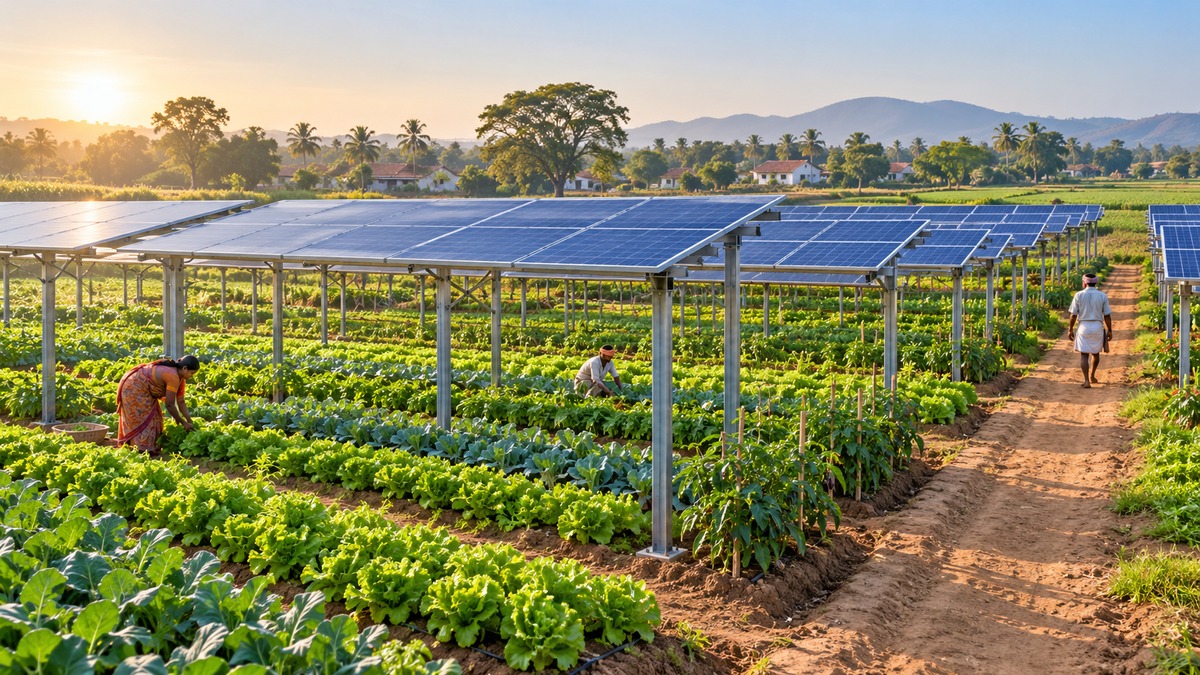
Agrivoltaics means combining agricultural activity and solar photovoltaic electricity generation on the same land. Its promise depends on the design of the combined system. Installing panels on farmland does not, by itself, demonstrate that farming has been successfully integrated. Crops, equipment, water, workers and electrical infrastructure all need space and an operating plan.
The concept: sharing land and sunlight
In a conventional solar-only installation, electricity production determines how most of the site is arranged. In an agrivoltaic project, agricultural production remains an explicit objective. Crops may occupy spaces below elevated panels or between panel rows. Wider definitions also include compatible livestock grazing and pollinator habitat, although this article concentrates on crop cultivation.
A solar-powered irrigation pump is a different idea. It describes the energy source used to pump water. Agrivoltaics describes the joint use of land for agriculture and solar generation. A farm can use a solar pump without cultivating below or between panels. Conversely, a jointly used plot can produce electricity for purposes beyond pumping.
Photovoltaic panels convert sunlight into electricity; crops use light for photosynthesis. Their coexistence therefore involves deciding how available light is shared across space and time. The practical objective is a workable combination of outputs. Maximising the number of panels on every available square metre may conflict with maintaining a productive crop area.
Design choices and their consequences
Panel height, row spacing and access routes influence whether cultivation is feasible. Raising panels can make work underneath easier, but additional structural material can raise installation costs. Wider spacing can admit more light and improve access, while reducing the amount of solar generation that can be accommodated on a given area. These are design trade-offs, not arguments for one universal layout.
Crop-specific designs must account for different plants’ sensitivity to shade and the seasonal distribution of light. A layout suited to one crop does not automatically suit another. Even the same field may require different working arrangements when crops are rotated. Planning should begin with the actual agricultural operation rather than treating cultivation as an activity to fit around a completed solar plant.
Consider a hypothetical field where a harvesting machine must pass between rows. A drawing that shows sufficient planted area but ignores the machine’s turning space could overstate agricultural compatibility. The example illustrates a general principle: usable farm space includes movement, servicing and handling areas, not only the area occupied by plants.
Shade, water and crop response
Partial shading can change the local conditions around plants. In some hot or dry settings, lower exposure can reduce soil evaporation and ease heat stress. These effects can be useful, but they do not guarantee higher yields for every crop. Too little light can also constrain growth. The direction and size of the result depend on the crop, climate and system configuration.
“Water saving” must also be defined carefully. Less evaporation is a physical process; lower irrigation use is a measured management outcome. They are related, but one should not replace measurement of the other. A meaningful comparison records water applied and crop output, rather than assuming that the presence of shade establishes a particular saving.
For example, if two plots receive different amounts of irrigation, comparing their harvests alone cannot isolate the effect of panels. Likewise, a wet season and a dry season are not interchangeable observations. A useful field study records the conditions under which an outcome occurred. This is why local trials and comparisons over multiple crop cycles matter.
Key distinctions for Prelims
| Term or claim | Correct interpretation |
|---|---|
| Agrivoltaics | Agriculture and solar photovoltaic generation share land. |
| Solar irrigation | Solar electricity supplies pumping; joint land use is not implied. |
| Partial shading | Changes light and local growing conditions; outcomes are crop-specific. |
| Installed capacity | Rated power capability; it is not electricity generated over a period. |
| Combined land productivity | Considers agricultural and electrical outputs against appropriate separate-use references. |
| Higher gross receipts | Do not establish higher net income without accounting for costs. |
The distinction between power and energy is especially important. Capacity is expressed in units such as kilowatts or megawatts; electricity over time is expressed in kilowatt-hours or megawatt-hours. A project’s capacity cannot be read as its annual generation. Duration, operating conditions and actual performance must enter the comparison.
How should success be measured?
Agrivoltaics produces two different outputs, so evaluation should avoid adding unlike quantities directly. Tonnes of crops and kilowatt-hours of electricity cannot simply be summed. Measures such as the land equivalent ratio compare combined production with suitable separate agricultural and solar reference systems. The choice of reference affects what the comparison means.
For administrative assessment, a broader dashboard would be useful: crop quantity and quality, electricity generated, water applied, operating costs, labour requirements and continued cultivation. These are proposed evaluation criteria, not a claim that one mandatory national scoring system already exists. The point is to make the agricultural and energy objectives visible together.
A hypothetical project could generate substantial electricity but make cultivation impractical. Another could retain crops yet deliver too little additional value to justify its costs. Both cases show why a single headline number is insufficient. A combined system should be evaluated against its stated objectives, and the people bearing costs should be identified alongside those receiving benefits.
Farm livelihoods: opportunity with conditions
Income diversification is a potential benefit. Electricity-related receipts or land-use payments may create an additional revenue stream. But the commercial arrangement matters: owning equipment, leasing land and sharing revenue involve different responsibilities. A general statement about additional income is not a promise that every participating cultivator will receive the same return.
A simple accounting distinction helps. Gross receipts record money received; net income also reflects relevant costs. Installation, maintenance and financing obligations cannot be ignored when assessing a project. This is an analytical framework, not an investment recommendation or a claim about any particular tariff, subsidy or guaranteed payback period.
Distribution also matters. A landowner, tenant cultivator, agricultural worker and electricity developer may experience the project differently. A policy assessment should ask whose access is protected, who can make cultivation decisions and who carries the risk of disruption. Counting only aggregate revenue can conceal these differences even when the overall project appears commercially attractive.
Challenges and a practical way forward
Technical, economic and organisational obstacles need attention. Designs can require additional investment; crop compatibility needs evidence; and farmers and solar operators may have competing operational priorities. The answer is not to assume that either activity can be managed independently. Their interaction is the central feature of the project.
For India, a sensible approach would begin with locally representative demonstrations. Trials should record both agricultural and energy performance, compare results with clearly described reference plots, and publish unfavourable as well as favourable outcomes. Replication should be based on conditions that can be reproduced, rather than on a striking result from a different climate.
Farmers should participate before the layout is fixed. Discussions should cover equipment access, crop rotation, maintenance timing and responsibility for restoring the site at the end of use. These are proposed safeguards for project design. They should not be mistaken for a description of a newly enacted legal framework.
Support institutions can also help translate trial results into usable decisions. Agricultural specialists can interpret crop response, engineers can assess the solar arrangement, and local organisations can explain operational concerns. This division of expertise is valuable because success requires a functioning farm and an electricity system at the same location.
Link to the static syllabus
The strongest GS III connections are agriculture, irrigation, infrastructure, energy and environmental sustainability. Geography adds land use and local climate; governance adds coordination and the distribution of benefits. In a Mains answer, explain the mechanism first, then examine benefits, limitations and implementation conditions. Avoid treating a technology label as proof of an assured social outcome.
Revision takeaway
Agrivoltaics links food production and solar generation through shared land. Its potential lies in compatible design, suitable crops and carefully assessed outcomes. Remember three distinctions: land sharing differs from solar pumping, capacity differs from generated electricity, and revenue differs from net income. The policy task is to demonstrate useful coexistence under local conditions.
Practise next: Attempt the related MCQs and revise agriculture, renewable energy and land-use notes in the IASLadder app.
Practicing UPSC Prelims PYQs?
Practice 45+ years of topic-wise previous year questions (1979–2026) with in-depth explanations on our mobile app.
Never miss a daily update
Join our official Telegram channel or WhatsApp group for daily current affairs and test alerts.
Frequently Asked Questions
Test yourself · 10 practice questions
Practice MCQs on Agrivoltaics: Growing Crops Alongside Solar Power
Check how well you understood this article with 10 UPSC-style multiple-choice questions — instant answers with detailed explanations.
View all questions with answersTags
Related Articles
Pumped Storage Hydropower: Energy, Efficiency and the Grid
Pumped storage moves electricity across time by raising water and later releasing it through turbines. Understand why energy losses do not …

Khelo India Sports Goods Scheme: Manufacturing and MSMEs
The new sports-goods manufacturing scheme connects equipment production with industrial policy. Explore shared facilities, anchor firms, ce…
National Unity Day: Patel, Integration and India’s Union
National Unity Day connects Patel’s legacy with the making of India’s constitutional Union. Understand how accession differed from administ…
Keep reading
More in Current Affairs
- Current Affairs PM Viksit Gram Swaraj Yojana: Panchayats and Local Governance
- Current Affairs Green Diwali 2026: Clean Air and Governance for UPSC
- Current Affairs Children’s Internet Rights and Online Safety: Supreme Court Order
- Current Affairs How to Use PIB, Yojana and PRS for UPSC: What Each Source Gives and How Much to Read
- Current Affairs How to Read and Use the Economic Survey for UPSC Without Reading All of It
- Current Affairs Best Way to Prepare Current Affairs for UPSC Mains: From Editorials to Answers