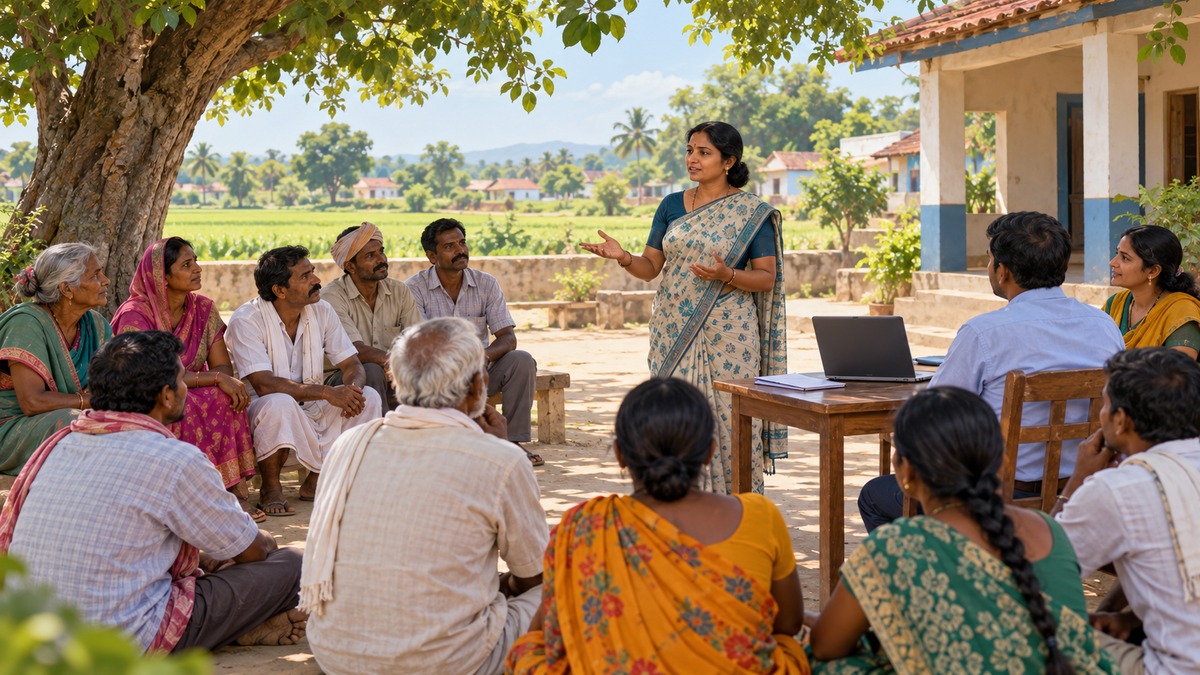
Why PM Viksit Gram Swaraj Yojana is in the news
On 28 October 2026, the Union Cabinet approved the Pradhan Mantri Viksit Gram Swaraj Yojana, or PM VGSY, as a Centrally Sponsored Scheme for 2026–27 to 2030–31. Its approved outlay is ₹7,395.55 crore, comprising ₹4,869.48 crore from the Centre and ₹2,526.07 crore from states. The initiative focuses on strengthening rural local governance through planning, capacity building, digital support and financial accountability.
The scheme covers all states and Union Territories, including traditional rural local bodies in non-Part IX areas where Panchayats do not exist. It envisages support across more than 2.55 lakh Panchayats and traditional local bodies. These are features of the approved design, checked on 29 October 2026; they should not be presented as completed implementation outcomes.
For UPSC and State PCS, the significance lies beyond the scheme's name or allocation. It connects GS II themes of decentralisation, local self-government, participation and accountability. The central issue is how elected institutions turn local needs, legal authority, public money and administrative capacity into functioning services.
The scheme in brief
| Feature | Approved position |
|---|---|
| Scheme type | Centrally Sponsored Scheme |
| Period | 2026–27 to 2030–31 |
| Total outlay | ₹7,395.55 crore |
| Implementation | State governments and Union Territory administrations |
| Planning tools | Gram Panchayat Development Plans and eGramSwaraj |
| Audit support | Online audit planning and completion through AuditOnline |
The scheme does not create permanent posts, although need-based contractual technical support may be engaged. Its planning approach brings departments together while retaining existing departmental arrangements for delivering individual schemes. Coordination should therefore not be confused with transferring every departmental power to the Panchayat.
Constitutional background: institutions and powers
The Seventy-third Amendment
The Constitution's Seventy-third Amendment added Part IX on Panchayats and the Eleventh Schedule, which lists 29 subjects. Part IX provides a framework for rural local self-government. Examples in the Eleventh Schedule include agriculture, drinking water, rural housing and maintenance of community assets. Their presence in the Schedule establishes an important constitutional reference, but not identical administrative arrangements in every state.
Article 243G enables state legislatures to endow Panchayats with powers for self-government, including preparing plans and implementing entrusted schemes for economic development and social justice. The role of state law matters. A new funding programme does not, by itself, automatically transfer all 29 subjects, every departmental employee or unrestricted spending authority to every village institution.
Gram Sabha and Gram Panchayat
The Gram Sabha consists of persons registered in the electoral rolls relating to a village within the village-level Panchayat area. It is not simply a committee of elected Panchayat members. The Gram Panchayat is the village-level institution of rural local self-government, while the Gram Sabha provides the wider body through which registered residents participate.
Under Article 243A, state law determines the powers and functions the Gram Sabha may exercise at village level. Keep this legal framework separate from a general recommendation that meetings should be inclusive. Participation is meaningful when residents receive understandable information, can discuss alternatives and can see what happened to the concerns they raised.
From a list of works to a development plan
A Gram Panchayat Development Plan, or GPDP, should connect local priorities with available resources and responsible institutions. A list of desired buildings is not enough. Planning requires identifying the problem, considering alternatives, estimating costs, establishing who will implement the work and anticipating how the resulting asset or service will be maintained.
Consider an illustrative village where a settlement has unreliable drinking water. A useful planning exercise would examine the source, distribution network, seasonal availability and maintenance arrangements. It would also listen to residents who collect water and identify the agency responsible for technical work. Constructing another tank without understanding the bottleneck may leave the original problem unresolved.
Participatory planning can uncover differences within a village. The main settlement may have good access while an outlying hamlet does not. A single village-wide average can conceal this gap. Discussions with women, disadvantaged groups, older residents and persons with disabilities can help identify needs that a standard project list misses.
Coordination across schemes is equally important. For example, a road project and a drainage improvement should be planned so that one does not undo the other. This is an illustration of convergence: related activities and resources are aligned around a local need. It does not authorise expenditure outside applicable rules or remove the responsibilities of specialised departments.
Digital systems: useful records, not automatic results
What eGramSwaraj contributes
eGramSwaraj supports Panchayat planning, progress reporting, work-based accounting and asset records. Connecting these stages can make it easier to follow a project from an approved activity to expenditure and reported progress. A consistent record also helps distinguish a proposed work from a sanctioned work or one reported as complete.
However, a digital entry is only as reliable as the process behind it. An uploaded photograph cannot independently establish that a facility works throughout the year. A completed expenditure entry does not necessarily show that intended users receive the service. Administrative records should be complemented by physical checks and feedback from the people affected.
AuditOnline and accountability
AuditOnline supports the auditing process for local-body accounts. Accounting records transactions; auditing examines those records and relevant compliance. Neither is the same as merely publicising an expenditure total. An audit can identify a discrepancy, but accountability also requires an explanation, corrective action and follow-up on unresolved observations.
Citizen discussion adds another perspective. Residents may report that a completed asset is inaccessible or unused even when expenditure records exist. Financial scrutiny and community feedback therefore serve related but different purposes. A strong governance system connects them instead of assuming that one portal or one meeting can replace every form of oversight.
Functions, funds and functionaries
The three familiar dimensions of decentralisation are functions, funds and functionaries. Functions concern responsibilities and decision-making authority. Funds concern the resources available to carry them out. Functionaries concern the people and skills required for implementation. These dimensions need to work together; responsibility without resources or technical support can remain largely formal.
Capacity building can help an elected representative read a budget, interpret a project estimate or monitor progress. It cannot alone supply a missing engineer, remove a legal restriction or ensure a timely fund release. The distinction matters when evaluating a governance scheme: training is valuable, but its results depend on the institutional setting in which participants work.
Practical support should therefore continue after a training session. A representative preparing a first plan may need help checking a cost estimate or recording a decision correctly. Assessing whether these tasks improve is more informative than counting attendance alone. Training numbers measure an activity; better decision-making and functioning services are outcomes.
Local finance and the limits of self-reliance
Article 243H allows state legislatures to authorise Panchayat taxation and provide for assigned revenues, grants and funds. Panchayats do not acquire unlimited taxing powers merely because a scheme encourages own-source revenue. The available powers, procedures and limits depend on the applicable legal framework.
Own-source revenue can improve local flexibility, but potential varies with the economic base and administrative capacity of an area. A poorer Panchayat may need predictable transfers even while improving collection of legally authorised revenues. Financial self-reliance should therefore be assessed alongside equity and service needs, rather than treated as a requirement that every village finance all services alone.
Article 243I provides for a State Finance Commission to review Panchayat finances, with commissions constituted at five-year intervals after the initial constitutional requirement. This state-level institution is distinct from the Union Finance Commission. Remember the distinction between reviewing local finances, authorising a tax and implementing a capacity-building scheme.
What effective implementation should address
Inclusion and understandable information
Meeting notices, timing, accessible venues and simple explanations influence who can participate. Publishing a technical document is not equivalent to making it understandable. Plain-language summaries and assisted access can help residents compare proposed activities, raise objections and follow decisions without requiring every person to operate a digital portal.
Reliable data and clear responsibility
Combining information across departments can improve planning only if records are accurate and responsibilities remain clear. Duplicate entries, outdated asset status or inconsistent beneficiary information can distort priorities. A useful system needs correction procedures, identifiable responsibility for updates and appropriate protection for personal information.
Maintenance and measurable outcomes
Plans should anticipate recurring maintenance, not only construction. For a water facility, the meaningful result is reliable service to users, not merely an asset recorded as complete. Review should examine functionality, equitable access, timely repair and whether residents can obtain a response when problems occur.
A balanced assessment of PM VGSY should therefore separate approved inputs, administrative outputs and public outcomes. Funding is an input; a prepared plan or completed audit is an output; better services and accountable decisions are outcomes. Tracking all three helps avoid both premature celebration and dismissal before implementation evidence is available.
Revision takeaway
- PM VGSY was approved on 28 October 2026 for 2026–27 to 2030–31 as a Centrally Sponsored Scheme.
- The Gram Sabha and Gram Panchayat are related but distinct institutions.
- Article 243G concerns Panchayat powers; Article 243H concerns taxation and funds; Article 243I concerns State Finance Commissions.
- eGramSwaraj supports planning and accounting; AuditOnline supports auditing.
- Capacity building, legal devolution and actual service improvement are different things.
- Judge participation by influence on decisions and plans by results for residents.
Practise the separate MCQs and revise your local-government notes on the IASLadder app.
Practicing UPSC Prelims PYQs?
Practice 45+ years of topic-wise previous year questions (1979–2026) with in-depth explanations on our mobile app.
Never miss a daily update
Join our official Telegram channel or WhatsApp group for daily current affairs and test alerts.
Frequently Asked Questions
Test yourself · 10 practice questions
Practice MCQs on PM Viksit Gram Swaraj Yojana: Panchayats and Local Governance
Check how well you understood this article with 10 UPSC-style multiple-choice questions — instant answers with detailed explanations.
View all questions with answersTags
Related Articles

Pumped Storage Hydropower: Energy, Efficiency and the Grid
Pumped storage moves electricity across time by raising water and later releasing it through turbines. Understand why energy losses do not …

Khelo India Sports Goods Scheme: Manufacturing and MSMEs
The new sports-goods manufacturing scheme connects equipment production with industrial policy. Explore shared facilities, anchor firms, ce…
National Unity Day: Patel, Integration and India’s Union
National Unity Day connects Patel’s legacy with the making of India’s constitutional Union. Understand how accession differed from administ…
Keep reading
More in Current Affairs
- Current Affairs Agrivoltaics: Growing Crops Alongside Solar Power
- Current Affairs SIMBEX 2026: India–Singapore Maritime Cooperation
- Current Affairs Green Diwali 2026: Clean Air and Governance for UPSC
- Current Affairs Children’s Internet Rights and Online Safety: Supreme Court Order
- Current Affairs How to Use PIB, Yojana and PRS for UPSC: What Each Source Gives and How Much to Read
- Current Affairs How to Read and Use the Economic Survey for UPSC Without Reading All of It