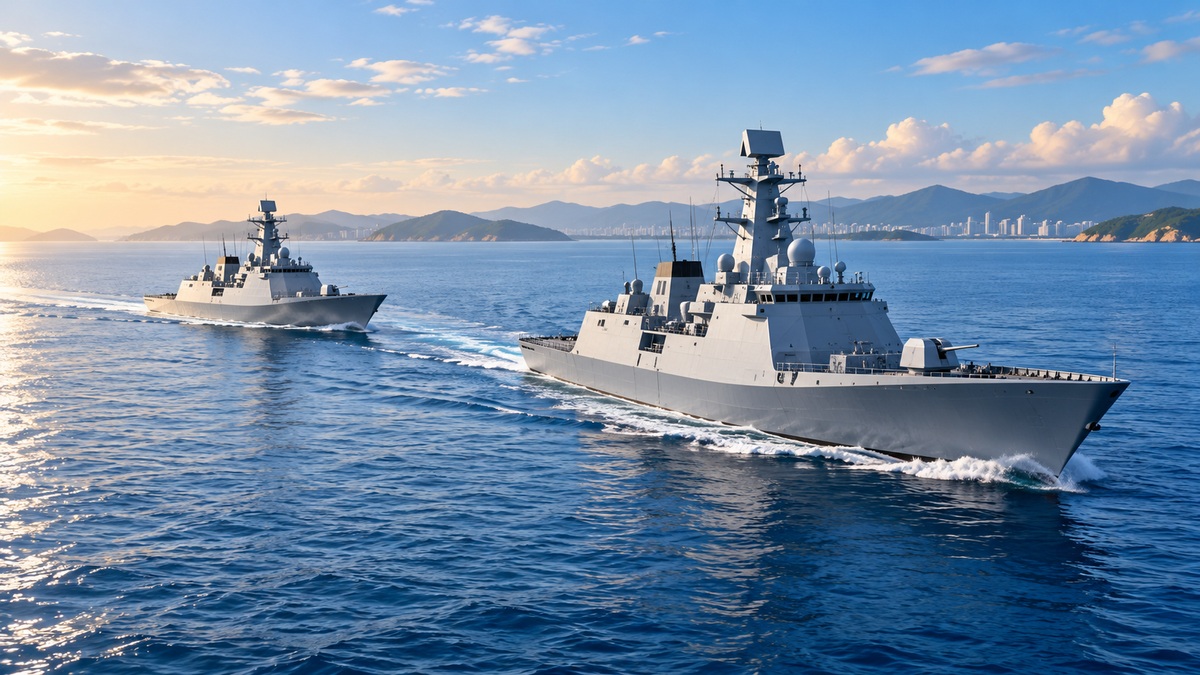
SIMBEX 2026: why a naval exercise matters beyond the ships
When two navies train together, the visible part is a group of ships at sea. The less visible part is learning how to communicate, plan and respond together. SIMBEX offers a useful way to connect a current defence development with the enduring ideas of interoperability, defence diplomacy and bilateral cooperation. For UPSC and State PCS, those distinctions matter more than memorising an unverified list of equipment.
The Defence Ministry announced on 21 October that the 33rd Singapore–India Maritime Bilateral Exercise was taking place at Visakhapatnam during 21–26 October 2026. The harbour phase covers 21–23 October; the sea phase is scheduled for 24–26 October in the Bay of Bengal. Facts were checked on 23 October. The scheduled sea phase should not yet be described as completed.
Background: a relationship built through repeated practice
Singapore's Ministry of Defence records that SIMBEX began in 1994 with an anti-submarine warfare focus. Its scope subsequently expanded to air, surface and underwater dimensions. The historical point is useful because it shows continuity as well as adaptation: a recurring exercise can preserve institutional familiarity while changing what participants practise.
A 2025 Singapore defence release described simulated naval training during the shore phase before sea activities. This is background from an earlier edition, not proof that every detail has been repeated in 2026. Keeping editions separate prevents a common current-affairs error: transferring last year's ships, aircraft or outcomes into this year's account without confirmation.
The value of continuity can be understood through an ordinary organisational comparison. Two teams may possess capable people yet struggle when they first work together because terminology, reporting practices and expectations differ. Repeated interaction can reveal those gaps. This is an analytical analogy, not a claim about a specific mistake made by either navy.
Harbour and sea phases: preparation and application
A harbour phase provides opportunities for professional discussion and preparation. A sea phase places activities in a maritime operating environment. The distinction helps explain why a naval exercise is more than a sailing event. Planning and practical execution address related but different questions, and neither should be dismissed merely because the other is more visually striking.
Consider a hypothetical shared task. Before starting, teams need a common understanding of the objective, responsibilities and communication arrangements. During execution, they must interpret information and coordinate actions. Afterwards, they need to identify what worked and what needs improvement. This planning–practice–review sequence explains the learning process without describing sensitive procedures or asserting unpublished exercise results.
For an examination answer, do not confuse an activity with a demonstrated outcome. Conducting a planning session shows that interaction occurred. Establishing how much it improved coordination requires further evidence. The same distinction applies to a sea drill: an announcement of participation does not by itself measure proficiency under every possible real-world condition.
Key terms that should remain distinct
| Term | Meaning in this discussion | Common mistake |
|---|---|---|
| Bilateral | Cooperation between two countries | Treating it as automatically involving an entire region |
| Interoperability | Ability to work together effectively | Assuming identical equipment is always required |
| Defence diplomacy | Defence interactions supporting wider relationships | Reducing cooperation to combat alone |
| Exercise | Organised training and practice | Treating training as an actual conflict |
| Strategic partnership | A framework for broader cooperation | Assuming an automatic mutual-defence obligation |
Interoperability concerns the ability to cooperate across differences. It should not be reduced to buying the same platform or displaying equipment together. Shared understanding, compatible communication and clear responsibilities can matter alongside technical systems. Conversely, owning similar equipment does not automatically prove that two organisations can coordinate effectively in a demanding situation.
Defence diplomacy refers here to the relationship-building role of professional military engagement. It can include habits of consultation and familiarity between institutions. An exercise can serve both training and diplomatic purposes. Those functions are compatible, but neither establishes a legal commitment to participate in every future operation undertaken by a partner.
Reading the broader India–Singapore relationship
India and Singapore elevated their relationship to a Comprehensive Strategic Partnership in September 2024. Their September 2025 joint statement described a broader roadmap covering economic cooperation, skills, digitalisation, sustainability, connectivity, healthcare, people-to-people exchanges, and defence and security. This context places naval cooperation within a relationship that extends well beyond the defence sector.
The phrase “comprehensive” should therefore prompt a wider view rather than a stronger unsupported military claim. A student can explain how different areas of cooperation reinforce communication and confidence while still recognising their distinct institutions and purposes. A shipping initiative, a training exercise and an educational exchange are not interchangeable programmes merely because they involve the same countries.
For example, Singapore's Maritime and Port Authority reported a September 2025 agreement on a green and digital shipping corridor with India. Its stated focus includes maritime digitalisation and decarbonisation. That civilian shipping initiative is useful context, but it is separate from SIMBEX. The exercise should not be described as implementing that corridor unless a specific source establishes the connection.
What the exercise can contribute: an analytical assessment
1. Professional familiarity
Repeated contact can make it easier for institutions to understand one another's working practices. Familiarity does not mean complete agreement on every issue. Its value lies in reducing avoidable confusion and making consultation more practical. An assessment should ask how learning is retained when personnel change, rather than assuming that a single successful interaction permanently solves coordination problems.
2. More credible cooperation
Diplomatic statements describe intentions, while practical engagement can help institutions explore how cooperation would work. Neither should be treated as sufficient on its own. A balanced argument connects expressed commitments with actual activities and then identifies the evidence still needed to evaluate results. This is stronger than simply counting the number of exercises as a complete measure of relationship quality.
3. Learning across organisational differences
Participants can encounter different approaches to preparation and professional problem-solving. The useful outcome is not necessarily uniformity. It may be a clearer understanding of which differences matter for a shared task and how to work with them. This is an analytical explanation of possible value, not a claim that a particular improvement has already been measured in SIMBEX 2026.
Limits and cautions for a balanced Mains answer
First, an exercise is a bounded training environment. Real situations may involve uncertainties that cannot all be reproduced in practice. It is reasonable to discuss training as preparation, but not to present it as a guarantee of future performance. Avoid turning a useful capability-building activity into an absolute promise.
Second, public information is incomplete by design. A press release may identify dates, participants and broad objectives without publishing an evaluation of every activity. Lack of public detail should not be filled with invented success rates or technical claims. Where the evidence only supports that an event began, write that it began.
Third, cooperation should not automatically be labelled as directed against a third country. In a June 2024 interview, Singapore's foreign minister described SIMBEX in terms of long-term confidence and trust and cautioned against characterising it as directed at another power. A responsible answer can discuss the regional context while separating its own analysis from an officially declared purpose.
Fourth, institutional benefits require follow-up. A useful analytical recommendation is to connect practice with review, record lessons and revisit identified gaps in later interactions. This is a suggested way to evaluate cooperation, not a claim about unpublished review procedures. Recommendations should be labelled clearly so that the reader can distinguish proposals from verified facts.
How to use this topic in UPSC and State PCS
For GS II, connect SIMBEX with bilateral relations and the role of institutions in sustaining international cooperation. For security-related study, examine maritime coordination and the difference between a training activity, an operation and a treaty obligation. Prelims preparation should begin with the participating countries, the character of the exercise and the correct status of the announced phases.
A short answer can follow a clear sequence: state the verified development, explain the key concept, assess possible benefits, then identify limits. Use precise verbs. “Scheduled,” “commenced” and “concluded” express different stages. Do not upgrade an intended activity into a completed achievement because the announcement uses confident language about its objectives.
No specific previous-year question is claimed here without its original paper and year being verified. The article also avoids unsupported claims about current ship capabilities. Its purpose is to connect a verified development with concepts that can be applied to other bilateral exercises without confusing their names, participating countries or declared scope.
Revision takeaway
- SIMBEX is a bilateral maritime exercise involving India and Singapore.
- Separate verified events from scheduled activities and analytical recommendations.
- Interoperability means effective cooperation, not necessarily identical equipment.
- A naval exercise does not by itself create a mutual-defence treaty.
- Defence cooperation is one part of a broader bilateral relationship.
- Evaluate learning and follow-up, not just participation or publicity.
Practice question
Two organisations possess similar equipment but cannot coordinate their reporting and responsibilities during a shared task. Does equipment similarity alone establish interoperability?
Answer: No. Interoperability concerns effective cooperation. Technical similarity can help, but shared understanding, communication and clear responsibilities also matter.
Practise next: Attempt the related MCQs and revise notes on bilateral relations and maritime cooperation in the IASLadder app.
Practicing UPSC Prelims PYQs?
Practice 45+ years of topic-wise previous year questions (1979–2026) with in-depth explanations on our mobile app.
Never miss a daily update
Join our official Telegram channel or WhatsApp group for daily current affairs and test alerts.
Frequently Asked Questions
Test yourself · 10 practice questions
Practice MCQs on SIMBEX 2026: India–Singapore Maritime Cooperation
Check how well you understood this article with 10 UPSC-style multiple-choice questions — instant answers with detailed explanations.
View all questions with answersTags
Related Articles

Pumped Storage Hydropower: Energy, Efficiency and the Grid
Pumped storage moves electricity across time by raising water and later releasing it through turbines. Understand why energy losses do not …

Khelo India Sports Goods Scheme: Manufacturing and MSMEs
The new sports-goods manufacturing scheme connects equipment production with industrial policy. Explore shared facilities, anchor firms, ce…

National Unity Day: Patel, Integration and India’s Union
National Unity Day connects Patel’s legacy with the making of India’s constitutional Union. Understand how accession differed from administ…
Keep reading
More in Current Affairs
- Current Affairs PM Viksit Gram Swaraj Yojana: Panchayats and Local Governance
- Current Affairs Immersive Technologies: AR, VR and Mixed Reality
- Current Affairs Children’s Internet Rights and Online Safety: Supreme Court Order
- Current Affairs How to Use PIB, Yojana and PRS for UPSC: What Each Source Gives and How Much to Read
- Current Affairs How to Read and Use the Economic Survey for UPSC Without Reading All of It
- Current Affairs Best Way to Prepare Current Affairs for UPSC Mains: From Editorials to Answers