What can a drain tell us about an ancient city?
A drain is more than a construction detail. Its route can reveal how a street and a house were connected, while repairs can show that people maintained the arrangement over time. Harappan cities are best understood by connecting such pieces of evidence. The aim is to explain urban life without turning every impressive structure into proof of a king, a palace or a modern municipal government.
For UPSC and State PCS, this approach brings together settlement planning, water management, crafts and the limits of archaeological interpretation. A strong answer distinguishes what archaeologists found from what they infer. It also recognises that a civilisation can share practices across a large region while individual settlements respond differently to their surroundings.
Harappan urbanism: the basic frame
The Mature Harappan urban phase is generally placed around 2600–1900 BCE. This is a broad chronological frame, not a claim that every settlement began and ended on the same dates. Earlier developments and later transformations belong to the longer Indus tradition. Keep the urban phase separate from the entire history of a particular site.
The civilisation is named after Harappa, one of its major archaeological sites. Mohenjo-daro and Dholavira provide important evidence, but no single city represents every feature of the whole civilisation. Comparisons are therefore essential. A feature securely identified at one settlement should not automatically be assigned to every other settlement.
“Urban” also means more than a large collection of buildings. It invites questions about occupations, exchange, shared facilities and the relationship between settlement and surrounding resources. The presence of specialised craft production, for example, raises different questions from the presence of a residential courtyard. Together, these clues help reconstruct an organised settlement economy.
Planning: order without assuming identical blueprints
UNESCO describes Mohenjo-daro through its planned urban remains, including substantial construction and a lower town arranged in an orderly pattern. Such evidence makes planning a reasonable interpretation. It does not establish that every street was built at once or that the settlement never changed. An archaeological plan can combine remains from different periods of occupation.
Think of planning as a relationship between spaces. Streets provide movement, houses accommodate daily activities, and shared structures require access. A change in one part may affect another. This analytical view is more useful than simply describing a city as “advanced,” because it explains what the arrangement enabled and what coordination it may have required.
Uniformity should also be handled carefully. Similar brick sizes or recurring forms can suggest shared practices, but the degree of similarity must be established from the evidence. Dholavira's extensive stone construction is a reminder that Harappan building material was not everywhere identical. Environmental setting and available materials mattered alongside broader cultural connections.
Water management: supply, storage and disposal
Water management includes several distinct tasks. Obtaining water, storing it and removing used water are related, but they are not interchangeable. A reservoir can support storage; a drain can carry water away. Finding one feature does not automatically establish that a settlement performed every other water-related task in the same way.
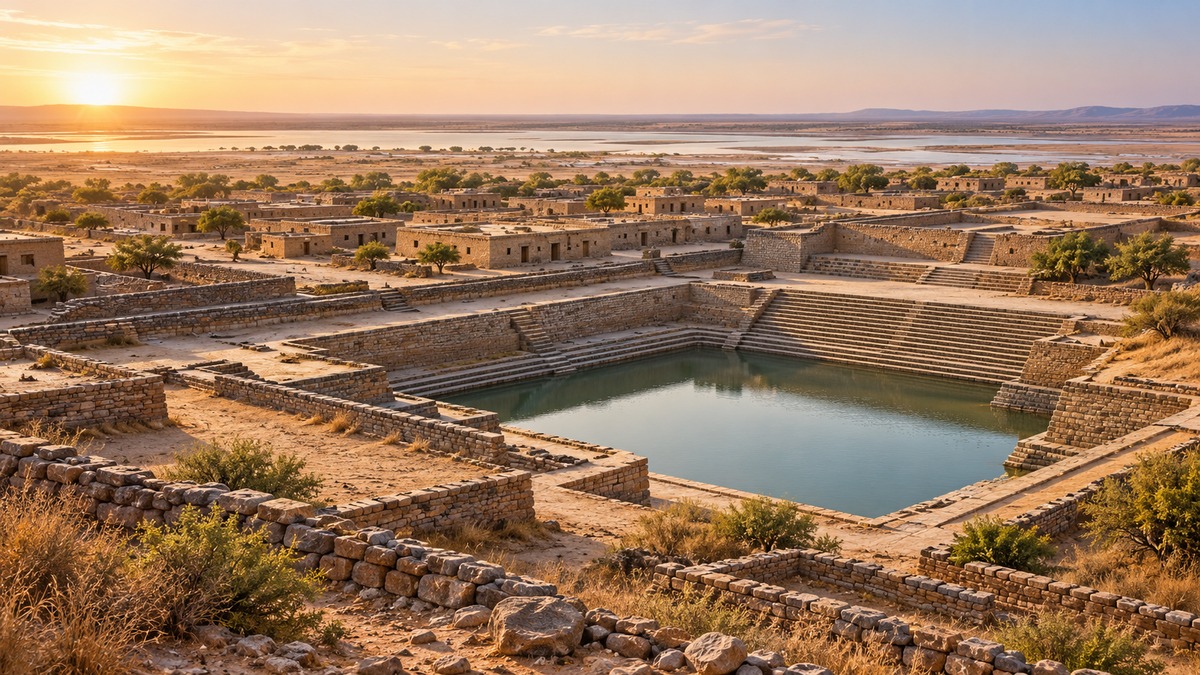
Dholavira, on Khadir island in Gujarat's arid environment, is particularly associated with reservoirs and drainage. Its remains show how settlement planning and water management can be studied together. Use the site as an example of a particular response to local conditions, rather than as a universal model for every Harappan town.
From an analytical perspective, a water structure also raises questions about maintenance. Who kept channels clear? How was access arranged? What happened when a structure needed repair? These are useful research questions, not answers already supplied by the mere existence of a reservoir. Engineering evidence can demonstrate organisation without revealing the exact name or form of the responsible institution.
Comparing evidence without mixing categories
| Evidence | What it helps investigate | What it does not establish alone |
|---|---|---|
| Street and building layout | Spatial organisation and access | A complete political constitution |
| Reservoirs and channels | Water collection, storage or movement | Modern water treatment standards |
| Weights | Measurement and exchange practices | A fully reconstructed tax administration |
| Craft debris and unfinished objects | Production activities | Every finished object's intended buyer |
| Inscribed seals | Use of signs and objects in communication | A securely readable royal genealogy |
The final column is not an argument that institutions or beliefs did not exist. It identifies the limit of a particular piece of evidence. A conclusion may become stronger when several independent observations support it. The important skill is to match the strength of the claim to the strength and context of the evidence.
Craft production: following the process
Harappan material culture includes beads, pottery, metal objects and other crafted goods. To identify production, archaeologists consider more than a finished object. Raw material, tools, unfinished pieces and waste can reveal stages of manufacture. A bead found in a house may indicate use or possession; a concentration of manufacturing debris can support a different interpretation.
This distinction is especially useful in a statement-based question. “An object was found here” is not equivalent to “the object was made here.” It may have been produced elsewhere and transported. Conversely, production evidence need not reveal the final destination of every item. Manufacture, movement and consumption are connected stages that require different kinds of evidence.
Research on Harappan crafts also cautions against assuming a single organisation for every activity. Different crafts may need different materials, working spaces and skills. The existence of specialisation does not by itself identify who owned a workshop or controlled its workers. An answer should explain the evidence for production before making wider claims about control.
Weights, exchange and shared practices
Standardised weights are an important part of Harappan evidence. Museum collections and archaeological research associate them with measurement and exchange. Shared measurement practices can make transactions more comparable across users. This is a meaningful institutional clue, even though it does not provide a complete written account of the system that supported those practices.
Consider a simple illustration. If two parties use incompatible units without any agreed conversion, comparing quantities becomes harder. Shared standards can reduce that difficulty. The illustration explains why measurement matters; it is not a reconstruction of a particular ancient transaction. Avoid converting this logical explanation into an unsupported claim about exact prices, salaries or taxes.
Likewise, standardisation and political centralisation are not synonyms. A common practice might be supported through different forms of organisation. To infer a specific political arrangement, additional evidence is needed. This is why statements moving directly from similar objects to a fully known empire should be examined with care.
Seals and the problem of reading the past
Harappan seals often carry signs and motifs. The script has not been securely deciphered through a generally accepted reading. Consequently, historians cannot use these inscriptions as they would a clearly readable account naming rulers and describing their achievements. Proposed readings should not be presented as settled historical fact.
That limitation does not make seals useless. Their material, manufacture, distribution and archaeological context can still be studied. An object may answer some questions while leaving others unresolved. Good historical reasoning identifies which questions can be addressed and which require evidence that is not yet available.
Common traps in Prelims and Mains
- Do not make every Harappan settlement a copy of Mohenjo-daro.
- Do not equate a reservoir with a drain or assume modern treatment standards.
- Do not infer local manufacture from the presence of a finished object alone.
- Do not turn standardisation automatically into proof of a known political system.
- Do not treat a disputed reading of the script as an established translation.
- Do not equate the end of an urban phase with the disappearance of every community.
For Mains, organise an answer around a claim and its evidence. If the claim concerns planning, discuss spatial relationships. If it concerns craft production, identify manufacturing indicators. If it concerns social or political organisation, explain both the inference and its limitations. This produces a clearer answer than listing impressive finds without connecting them.
For State PCS, site identification remains useful, but pair each name with a securely established characteristic. Dholavira's water-management remains, for example, provide a better foundation than a speculative claim about a ruler. No particular previous-year question or recent discovery is claimed here without verification of its original source.
Quick revision
The central lesson is shared urban traditions with local variation. Buildings, water structures, craft remains, weights and seals illuminate different aspects of life. None should be asked to prove everything. Distinguish observation, interpretation and uncertainty, and keep the date of a cultural phase separate from the full history of a settlement.
Practice question
A finished bead is discovered in a residential room. Does this alone prove that the room was a bead-making workshop?
Answer: No. It establishes the object's presence, but manufacture would need additional evidence such as tools, unfinished pieces or production waste. The bead could have been brought from elsewhere.
Practise next: Attempt the related MCQs and revise notes on Harappan sites and archaeological evidence in the IASLadder app.
Practicing UPSC Prelims PYQs?
Practice 45+ years of topic-wise previous year questions (1979–2026) with in-depth explanations on our mobile app.
Never miss a daily update
Join our official Telegram channel or WhatsApp group for daily current affairs and test alerts.
Frequently Asked Questions
Test yourself · 10 practice questions
Practice MCQs on Harappan Cities: Planning, Water and Archaeological Evidence
Check how well you understood this article with 10 UPSC-style multiple-choice questions — instant answers with detailed explanations.
View all questions with answersTags
Related Articles

Colonial Land Revenue: Permanent, Ryotwari and Mahalwari
What was permanent in the Permanent Settlement, and what did direct settlement with a ryot actually change? Compare colonial revenue system…

Constitutional Writs: Articles 32 and 226 Explained
Constitutional remedies depend on the right involved and the legal defect requiring correction. Understand how Articles 32 and 226 differ, …

Ocean Currents, Upwelling and Climate: A Conceptual Guide
Why can a sunny coast have cold water and rich fisheries? Understand how winds, rotation and density shape ocean circulation. This guide ex…
Keep reading
More in Optional & Subjects
- Optional & Subjects Fiscal, Revenue and Primary Deficits: Reading the Budget
- Optional & Subjects CRISPR-Cas9 Gene Editing: How It Works and Its Limits
- Optional & Subjects Inflation in India: CPI, WPI and GDP Deflator
- Optional & Subjects Western Disturbances: Why North India Gets Winter Rain
- Optional & Subjects Soils of India: Types, Distribution and Key Features
- Optional & Subjects Indian Monsoon Explained: Mechanism, Branches and Breaks