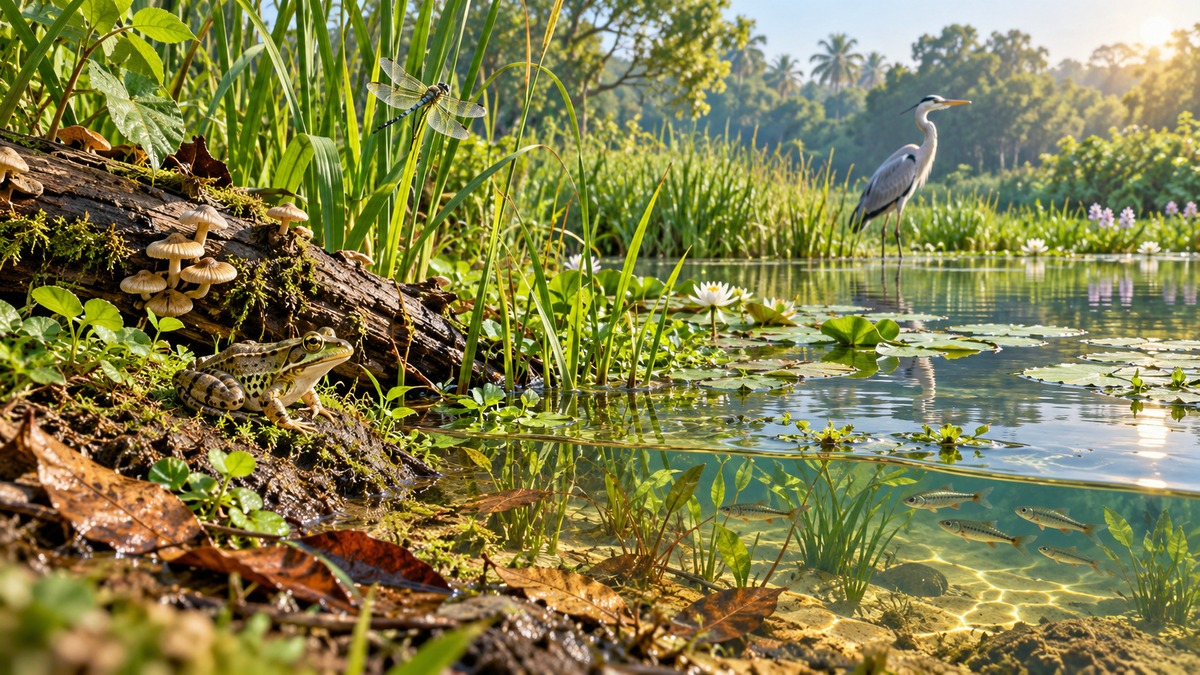
Energy flows through an ecosystem; nutrients circulate
A pond can contain less plant biomass than animal biomass at a particular moment and still depend on plants for its food supply. The apparent contradiction disappears when we distinguish a stock from a flow. Biomass records what is present when measured; productivity records how rapidly new organic matter is made. Small, rapidly reproducing producers can replenish food repeatedly while consumers continue feeding.
This distinction connects food chains, ecological pyramids and ecosystem functioning. For UPSC and State PCS, the useful starting point is that organisms transfer both matter and energy when they feed, but the two follow different long-term pathways. Nutrient elements can be reused. Energy becomes progressively dispersed as heat, so ecosystems require continuing energy inputs.
Producers establish the food base
An ecosystem includes living organisms and the physical environment with which they interact. Plants, algae and photosynthetic microorganisms capture light energy and use it to build organic compounds. They are producers, also called autotrophs. Animals obtain organic food from other organisms and are consumers. Many fungi and bacteria obtain nourishment by breaking down dead organic material.
Calling plants producers does not mean that they create energy. Photosynthesis converts incoming light energy into chemical energy stored in organic molecules. Some of that organic material supports the producer’s own metabolism; some becomes new tissue or enters other organisms through feeding and decomposition.
Sunlight supports most familiar ecosystems, but it is not the immediate energy source for every producer community. Around some deep-sea hydrothermal vents, chemosynthetic microorganisms use energy from chemical reactions to build organic matter. The relevant distinction is between the energy source and the producer’s role: both photosynthetic and chemosynthetic autotrophs supply organic material to food webs.
Food chains simplify a connected food web
A food chain traces one feeding pathway. In an illustrative sequence of grass, grasshopper and insect-eating frog, grass is the producer, the grasshopper is the primary consumer and the frog is the secondary consumer. The arrow in a conventional food-chain diagram points from the food organism towards the organism eating it. It indicates the direction of energy transfer.
A trophic level is a feeding position, not a permanent label attached to an entire species. An omnivore can feed at more than one trophic level: eating plant material places it on one pathway, while eating a herbivore places it higher on another. Real feeding relationships therefore form a food web, with multiple connected routes.
This makes a web more informative than a single chain, but a web is still a model. It may omit seasonal changes, differences between young and adult animals, and the quantities transferred along each connection. A line showing that one organism eats another does not, by itself, reveal how much of its diet that food supplies.
Grazing and detritus pathways operate together
A grazing food chain begins with living producers being eaten by herbivores. A detritus food chain begins with dead organic matter, including fallen leaves, remains and wastes. Both routes occur within the same ecosystem. Material that escapes grazing may eventually enter the detrital pathway, while animals feeding on detritus can themselves become prey.
Detritivores and decomposers should be distinguished. Detritivores, such as earthworms, ingest dead material and help fragment it. Decomposer microorganisms, especially bacteria and fungi, break down organic compounds through enzymatic processes. The categories describe different activities in decomposition rather than two unrelated ecological systems.
Decomposers are not simply a final step after the largest predator. They act on material originating at many trophic levels. Their activity releases mineral nutrients that producers can use again. The energy they obtain from organic matter supports their own metabolism and is ultimately dissipated; decomposition does not turn this heat back into usable sunlight.
Gross and net primary productivity
Primary productivity measures the rate at which producers form organic matter. Gross primary productivity, or GPP, represents the total production before accounting for the producers’ respiratory expenditure. Net primary productivity, or NPP, is what remains after that expenditure. When measured consistently over the same area and time, the relationship is NPP = GPP − producer respiration.
NPP contributes to growth and supplies organic material to herbivores and the detrital food web. It is not the amount actually eaten by herbivores: some tissue remains standing, some is shed and some dies without being grazed. Confusing production with consumption conceals these alternative destinations.
Units help separate the concepts. Biomass may be reported as grams of dry mass per square metre. Productivity needs a time denominator, such as grams of dry mass per square metre per year. Energy flow likewise needs a common area and time basis, for example kilojoules per square metre per year.
Why less energy reaches higher trophic levels
Not all material at one level is eaten by the next. Of the food eaten, some is not assimilated. Of the assimilated energy, much supports respiration, movement, maintenance and other life processes. Only a portion becomes new consumer biomass that can support another feeding level.
The familiar ten-percent rule is a useful simplified approximation for transfer between successive trophic levels. It is not an exact efficiency shared by every species and ecosystem. Actual transfer depends on food quality, physiology and environmental conditions. It also does not mean that plants capture ten percent of all incoming sunlight.
Nor does all energy absent from the next grazing level immediately become heat. Uneaten material and wastes can carry chemical energy into the detrital pathway. Across the full system, however, metabolic use disperses energy as heat. Repeated transfers leave a progressively smaller energy supply for higher consumers, helping explain why food chains cannot support unlimited additional levels.
Three ecological pyramids measure different things
| Pyramid | What is compared | Interpretation |
|---|---|---|
| Numbers | Individuals at each trophic level within a defined area | Can be upright or inverted; individual size is not represented |
| Biomass | Standing mass at each trophic level | Can be inverted when producer biomass is replaced rapidly |
| Energy | Energy flow across trophic levels per unit area per unit time | Always upright in a correctly defined trophic comparison |
A tree supporting numerous herbivorous insects illustrates why numbers can mislead. Counting one tree as one individual gives no indication of its large mass or productive surface. A numerical pyramid is answering a counting question, not measuring the amount of energy available.
Aquatic systems provide the classic biomass distinction. Phytoplankton may have a small standing biomass because they are consumed rapidly, yet their rapid reproduction can sustain a larger standing biomass of zooplankton. Such an inverted biomass pyramid does not violate energy transfer constraints. The snapshot of biomass and the production occurring through time are different measurements.
Energy pyramids remain upright because higher levels receive only part of the production supporting the preceding level. Comparing one level’s daily flow with another level’s annual flow would not be valid. Neither would comparing measurements from different areas without adjustment. The measurement boundary is part of the interpretation.
What simple pyramids leave out
Ecological pyramids are useful summaries, but a single stack cannot fully represent a food web. Omnivores may occupy multiple feeding positions, and decomposers receive material from several levels. Seasonal migration and external organic inputs can also complicate a local picture. These limitations do not invalidate the concepts; they explain why the underlying measurements must be understood.
For example, a pond may receive fallen leaves from surrounding trees. An assessment limited to plants growing inside the water could miss part of the energy entering its detrital web. Before interpreting an unusual result, establish which organisms, inputs, area and period the study includes.
Applying the concepts to environmental management
Nutrient enrichment shows why greater production is not automatically an improvement. Excess nitrogen or phosphorus can stimulate algal growth under suitable conditions. When organic material is decomposed, microbial respiration can consume dissolved oxygen. A water body may therefore experience abundant algal growth alongside conditions harmful to fish.
The management lesson is to examine processes together: nutrient inputs, production, decomposition, oxygen availability and changes in the living community. A single observation of green water or high biomass cannot establish ecological health. Similarly, conserving a visible predator also requires attention to its prey, producers and habitat conditions.
These connections fit GS III environment and conservation, while food-web interpretation and pyramid distinctions support Prelims. A strong explanation links an intervention to a mechanism: controlling nutrient inputs addresses the driver of excessive growth, while monitoring oxygen helps detect one of its consequences. Neither measurement replaces the other.
Quick revision
- Energy moves through feeding pathways and is dissipated as heat; nutrient elements can be recycled.
- Food-chain arrows point from food to consumer, and omnivores can occupy multiple trophic positions.
- NPP equals GPP minus producer respiration; biomass is a stock and productivity is a rate.
- Detrital pathways receive material from many levels, not only the final predator.
- Number and biomass pyramids may be inverted; a correctly constructed energy pyramid is upright.
- The ten-percent rule is an approximation, not a universal measured efficiency.
Practise next: Attempt related MCQs and revise quick notes on ecosystem functioning in the IASLadder app.
Practicing UPSC Prelims PYQs?
Practice 45+ years of topic-wise previous year questions (1979–2026) with in-depth explanations on our mobile app.
Never miss a daily update
Join our official Telegram channel or WhatsApp group for daily current affairs and test alerts.
Frequently Asked Questions
Test yourself · 10 practice questions
Practice MCQs on Ecosystem Energy Flow: Food Chains and Ecological Pyramids
Check how well you understood this article with 10 UPSC-style multiple-choice questions — instant answers with detailed explanations.
View all questions with answersTags
Related Articles
Colonial Land Revenue: Permanent, Ryotwari and Mahalwari
What was permanent in the Permanent Settlement, and what did direct settlement with a ryot actually change? Compare colonial revenue system…

Constitutional Writs: Articles 32 and 226 Explained
Constitutional remedies depend on the right involved and the legal defect requiring correction. Understand how Articles 32 and 226 differ, …

Ocean Currents, Upwelling and Climate: A Conceptual Guide
Why can a sunny coast have cold water and rich fisheries? Understand how winds, rotation and density shape ocean circulation. This guide ex…
Keep reading
More in Optional & Subjects
- Optional & Subjects Plate Tectonics: Boundaries, Earthquakes and Mountains
- Optional & Subjects CRISPR-Cas9 Gene Editing: How It Works and Its Limits
- Optional & Subjects Inflation in India: CPI, WPI and GDP Deflator
- Optional & Subjects Western Disturbances: Why North India Gets Winter Rain
- Optional & Subjects Soils of India: Types, Distribution and Key Features
- Optional & Subjects Indian Monsoon Explained: Mechanism, Branches and Breaks