Why does rain fall in northern India during the cold season?
Most of India’s familiar rainfall arrives with the summer monsoon. Yet Punjab, Haryana, Rajasthan, Delhi, Himachal Pradesh, Uttarakhand, Jammu and Kashmir and Ladakh can receive rain or snow in winter, when much of the country is dry. The key weather systems are western disturbances. Understanding them connects atmospheric circulation to Himalayan snowfall, rabi agriculture, winter hazards and several recurring geography concepts.
A western disturbance is not simply a rain-bearing wind. It is a moving weather system embedded in the mid-latitude westerlies. Its effects depend on its path, strength, the moisture available to it, the position of the jet stream and the terrain it encounters. That is why one disturbance may bring light rain to the plains, another heavy snow to the mountains, and a third little precipitation over a particular district.
What is a western disturbance?
“Western” describes the system’s approach from the west and its general eastward movement across West and South Asia. “Disturbance” refers to a perturbation in the usual atmospheric flow: a trough or cyclonic circulation that changes winds, cloud cover and pressure and can produce precipitation. In Indian weather analysis, a disturbance may be identified aloft as a trough in the subtropical westerlies, as an upper-air circulation, or through a combination of features at different levels.
These are extra-tropical systems, formed in the circulation of the middle latitudes. They are distinct from tropical cyclones, which develop over warm tropical oceans and have a different structure, and from the southwest monsoon, which is a seasonal circulation bringing moisture-laden winds from the Indian Ocean. The phrase “western disturbance” is used especially for systems that affect the Indian subcontinent; comparable mid-latitude systems occur elsewhere.
Textbook summaries often describe their source region as the Mediterranean. Meteorological descriptions also include the Caspian region and the wider west Asian corridor. It is safer to remember the broad route and circulation than to treat one sea as the fixed birthplace of every event. Individual systems vary in their development, track and intensity.
How does one travel towards India?
In winter, the subtropical westerly jet stream is an important steering current over and north of the subcontinent. A disturbance embedded in the westerlies generally moves from west to east. In operational charts, it may first appear as an upper-level trough over West Asia, then be tracked across Iran, Afghanistan and Pakistan towards northwest India. The system’s shape and level can evolve as it moves; it is not always a neat, circular low visible at the surface.
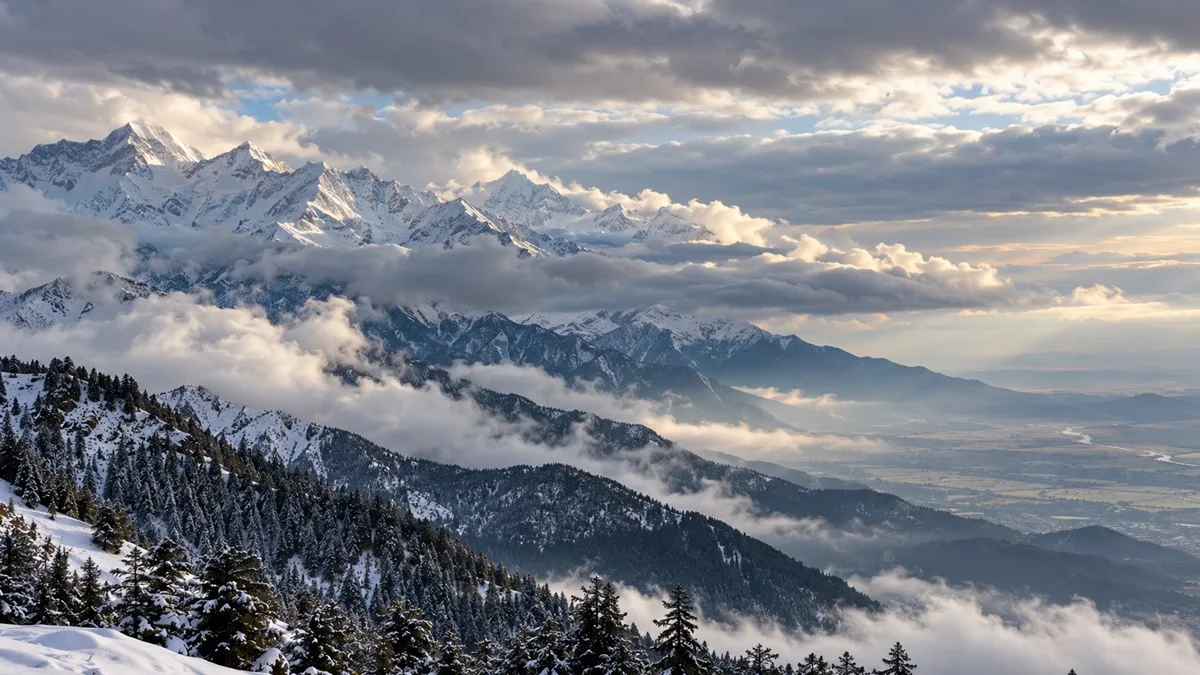
As the disturbance approaches the Himalayas, air is lifted and the circulation interacts with the mountain barrier. Moisture in the atmospheric column cools as air rises; water vapour condenses into cloud and can fall as rain in lower and plain areas or snow at higher elevations when temperatures allow. The amount and form of precipitation depend on temperature through the depth of the cloud, moisture supply, wind direction, elevation and the system’s speed.
The Himalayas therefore influence where a disturbance gives precipitation, but they do not act as a simple switch. Parts of the western Himalaya often receive snowfall, while adjoining northwest plains may receive rain. Some systems also affect central or eastern parts of north India. Local topography and atmospheric conditions create sharp differences across short distances.
Why are western disturbances important in winter?
For the western Himalayan region, winter precipitation helps build seasonal snow cover. Snow and rain contribute to the region’s water system, although the timing and later melt determine when that water becomes available. A single snowfall event should not be treated as a direct measure of long-term water security: storage, temperature, glacier and snow conditions, runoff and demand all matter.
In the northwest plains, winter showers can provide useful moisture to rabi crops such as wheat and mustard. The benefit is conditional. Light or moderate rain at a suitable growth stage may reduce irrigation needs, but rain at the wrong time, strong winds, hail, waterlogging or prolonged cloud can damage standing crops and delay field work. A useful exam answer therefore avoids calling every western disturbance either a “blessing” or a “disaster.” Its agricultural effect depends on amount, timing, location and crop stage.
These systems also shape daily winter weather. Cloud cover can limit daytime heating and alter night-time cooling; rain, snowfall and wind can affect transport, tourism, aviation and outdoor work. After a system moves away, the air mass and wind pattern can change. The exact temperature response varies, so it should not be reduced to a rule that every disturbance necessarily creates a cold wave or fog.
When and where are their effects felt?
Western disturbances are most closely associated with the cool season and the months around winter, when the westerly circulation is active over the region. Their influence is often discussed from late autumn into spring, though systems can occur outside that broad period. The western Himalaya and northwest plains are the core areas for many events, but the reach of a particular system can extend farther east or south when its circulation interacts with other features.
That interaction matters. A western disturbance can combine with a lower-level circulation, a trough, or moisture-bearing easterly flow. Such combinations can strengthen ascent and produce heavier or more widespread precipitation than the western disturbance alone might suggest. An IMD-led study of the 26–29 December 2024 event describes a western disturbance interacting with an easterly trough, with moisture contributions from both the Arabian Sea and the Bay of Bengal. The lesson is not that every disturbance causes extreme weather; it is that weather systems can interact.
Benefits and hazards: read the event, not just the label
| Possible contribution | Possible risk |
|---|---|
| Winter moisture can support rabi crops and supplement irrigation. | Excess rain, hail or untimely precipitation can damage crops. |
| Snowfall contributes to seasonal snow cover in mountain catchments. | Heavy snow can disrupt roads, flights, power and access to remote settlements. |
| Precipitation replenishes some local water stores. | Intense rain on steep slopes can raise landslide, runoff and flood risks. |
| Clouds and precipitation are part of the region’s seasonal climate. | Thunderstorms, lightning, strong winds and avalanche conditions may accompany some events. |
Forecasting is therefore a practical public service, not merely a way to name a system. District-level warnings, snow and rain observations, crop advisories and transport planning help convert a weather forecast into a decision. In mountain areas, the same rainfall total can have different consequences depending on slope, soil moisture, snow conditions, drainage and settlement location.
Western disturbance, monsoon and tropical cyclone: do not mix them up
| Feature | Western disturbance | Southwest monsoon | Tropical cyclone |
|---|---|---|---|
| Basic character | Extra-tropical weather system in the westerlies. | Seasonal wind and rainfall circulation over South Asia. | Organised rotating storm that forms over tropical or adjoining seas. |
| Usual movement relevant to India | Generally west to east. | Moist flow advances across India from the south and southwest in the monsoon season. | Track varies with steering winds and regional conditions. |
| Typical Indian association | Winter rain in the northwest and snow in the western Himalaya. | Most of India’s widespread summer rainfall. | High winds, heavy rain and storm surge risk near affected coasts. |
This comparison describes broad patterns, not absolute boundaries. A western disturbance can interact with monsoon-season moisture, and a tropical cyclone can influence inland weather after landfall. In a question, identify the system from its circulation, season, path and region rather than from rainfall alone.
Prelims facts and common traps
- “Western” refers to the approach and broad direction of travel, not to rain falling only in western India.
- Western disturbances are extra-tropical and are associated with the westerly circulation; they are not the southwest monsoon.
- They can bring rain to plains and snow to higher elevations, depending on temperature and terrain.
- The subtropical westerly jet helps steer many systems, but a jet stream is not itself a western disturbance.
- Not every disturbance produces rain at every location. Track, moisture, intensity and local relief matter.
- Heavy precipitation may result from interaction with other weather features, so avoid attributing every extreme event to one system alone.
How to use the topic in a Mains answer
For a “what are western disturbances?” question, define the system, locate its broad west-to-east route, explain the westerly steering flow and show how uplift near the Himalayas produces different forms of precipitation. Then discuss significance and risk in balanced terms: rabi moisture and mountain snow cover on one side; crop losses, transport disruption and slope hazards on the other.
For a question on climate variability or disaster preparedness, separate the event scale from the climate scale. One intense spell does not by itself prove a long-term trend. A sound analysis would examine frequency, intensity, timing, track, precipitation phase and regional observations over a defined period. Add practical measures such as timely IMD warnings, local crop advisories, resilient mountain roads and land-use decisions that account for slope and drainage. This structure shows both physical understanding and governance relevance without making unsupported predictions.
Revision takeaway
Remember the chain: a mid-latitude disturbance travels east with the westerlies; its circulation and moisture interact with regional conditions; rising air and Himalayan relief help produce winter rain and snow. Its benefits and hazards depend on where, when and how intensely precipitation occurs.
Practicing UPSC Prelims PYQs?
Practice 45+ years of topic-wise previous year questions (1979–2026) with in-depth explanations on our mobile app.
Never miss a daily update
Join our official Telegram channel or WhatsApp group for daily current affairs and test alerts.
Frequently Asked Questions
Test yourself · 10 practice questions
Practice MCQs on Western Disturbances: Why North India Gets Winter Rain
Check how well you understood this article with 10 UPSC-style multiple-choice questions — instant answers with detailed explanations.
View all questions with answersTags
Related Articles
Colonial Land Revenue: Permanent, Ryotwari and Mahalwari
What was permanent in the Permanent Settlement, and what did direct settlement with a ryot actually change? Compare colonial revenue system…

Constitutional Writs: Articles 32 and 226 Explained
Constitutional remedies depend on the right involved and the legal defect requiring correction. Understand how Articles 32 and 226 differ, …
Ocean Currents, Upwelling and Climate: A Conceptual Guide
Why can a sunny coast have cold water and rich fisheries? Understand how winds, rotation and density shape ocean circulation. This guide ex…
Keep reading
More in Optional & Subjects
- Optional & Subjects Fiscal, Revenue and Primary Deficits: Reading the Budget
- Optional & Subjects Ecosystem Energy Flow: Food Chains and Ecological Pyramids
- Optional & Subjects Harappan Cities: Planning, Water and Archaeological Evidence
- Optional & Subjects Plate Tectonics: Boundaries, Earthquakes and Mountains
- Optional & Subjects CRISPR-Cas9 Gene Editing: How It Works and Its Limits
- Optional & Subjects Indian Monsoon Explained: Mechanism, Branches and Breaks